The Real Threat Isn’t AI, It’s Ambiguity
AI isn’t killing creative teams.
Ambiguity is.
Most agencies feel the shift already: clients want faster ideas, tighter rationale, and sharper strategic thinking—all while creative teams juggle tools, expectations, and unclear direction about how AI actually fits into their roles.
When creatives don’t know what AI is for, what “good” looks like, or how leadership expects them to use it, their confidence drops and revision loops multiply. What agencies call “AI hesitation” is usually just a lack of structure.
Here’s the truth most agencies avoid saying out loud:
Creative teams don’t need more AI tools—they need a system for using them.
That’s the goal of this blog.
You’ll leave with:
- A clear model (C3M: Creative AI Confidence Model)
- Real examples of untrained vs. trained AI usage
- A practical workflow you can apply tomorrow
- Mindset, skill, and process upgrades that reduce chaos instead of increasing it
This isn’t about turning creatives into prompt engineers.
It’s about giving them the clarity, structure, and leadership alignment they need so AI becomes a confidence multiplier—not another pressure point.
Why Creative Teams Are At The Centre Of AI Adoption
Creative teams sit closest to where AI has the biggest impact:
ideas, concepts, comps, drafts, and client-facing creative rationale.
That means they also sit closest to where things break when AI is adopted without clarity.
Most AI breakdowns inside agencies fall into three predictable patterns:
The “Untrained AI Chaos” Scenario
This is what it looks like when creatives are told to “use AI” without direction:
- One designer uses Midjourney v4, another uses v6
- A writer uses ChatGPT for ideation, another for full drafts
- No one knows who owns prompting, review, or refinement
- PMs see deliverables that don’t match expectations
- Design leads have to “fix” AI-generated layouts that were supposed to save time
- Quality wobbles, revisions spike, timelines slip
Creative directors describe this stage the same way:
“AI was supposed to make us faster, but the team suddenly became less predictable.”
This isn’t a tool problem. It’s a leadership and clarity problem.
The “Creatives Are Afraid To Ask” Pattern
Most creatives privately admit one of these:
- “I’m not sure what leadership wants from me with AI.”
- “I’m scared I’ll use it wrong.”
- “I don’t want anyone thinking AI is doing my job for me.”
That fear turns into hesitation.
Hesitation turns into inconsistent adoption.
And inconsistent adoption turns into operational drag.
Agency Core makes this pattern explicit:
Creatives don’t resist change—they resist unclear change.
The Shift From Execution → Strategy Is Already Happening
AI accelerates execution.
That means creatives who only execute fall behind.
But creatives who lead AI gain:
- More strategic seats in pitches
- Stronger rationale behind ideas
- Faster exploration early in projects
- Better articulation of choices
- Clearer direction for clients
This is why C3M (Creative AI Confidence Model) starts with creative leadership, not tools:
- Mindset clarity
- Skill fluency
- Process predictability
When creatives lead AI—instead of reacting to it—the agency gets faster and smarter.
Part 1 – Build The Right Mindset: The Shift That Unlocks AI Confidence
Before creatives can lead AI, they need a mindset shift that removes fear,
ambiguity, and silent resistance.
Not because creatives are reluctant—but because leadership often signals AI adoption in ways that create uncertainty instead of clarity.
Here’s the core truth:
Most creative teams don’t fear AI. They fear not knowing what AI means for their roles.
That’s why the first pillar of the C3M (Creative AI Confidence Model) is Mindset Clarity. Without it, skill training is wasted and process design won’t stick.
Let’s break down the mindset barriers and how to dismantle them.
Reframe AI From Threat To Creative Leverage
Where mindset typically breaks:
Before (Unclear AI)
- Is AI supposed to replace part of my job?
- If I use AI, does that make my work less original?
- Is leadership measuring me against machine output?
This creates a defensive posture, and defensive creatives don’t experiment—they protect.
After (Clear AI Leadership)
- “AI handles exploration so I can spend more time refining the work clients pay for.”
- “My originality matters more, not less, because AI produces the generic version.”
- “I use AI the same way a senior uses a junior—to accelerate options.”
This simple reframe increases adoption dramatically.
When creatives understand AI is leverage, not competition, they shift from passive to proactive.
Give Creatives Certainty About Expectations
This is where 90% of agencies fail.
Leadership says:
“Use AI wherever it makes sense.”
Creatives hear:
“I’m being judged on criteria no one explained.”
The fix is explicit, agency-wide clarity:
- Where AI is expected (ex: concepting, moodboards, early copy passes)
- Where AI is not expected (ex: final brand expressions, high-fidelity deliverables)
- How AI output is reviewed
- What “good” looks like
- Who owns prompting and iteration
Example of a simple expectation guideline:
“AI assists the first 20–30% of exploration. Creatives own the remaining 70–80%.”
This reduces friction instantly.
Normalize Learning Instead Of Comparison
If creatives feel they’re being measured against teammates who pick up AI faster, they’ll regress.
Your job as leadership is to normalize:
- Learning curves
- Experimentation
- Imperfect outputs
- Shared wins
- Non-judgmental exploration
A quick tactic we see work in agencies:
10-Minute AI Standups (Weekly)
- 1 creative shares something they tried
- 1 shares what didn’t work
- 1 shares a new prompt structure
No pressure.
No decks.
Pure learning.
When AI learning becomes collective instead of competitive, confidence rises across the board.
Part 2 – Develop The Right Skills: What Creative Teams Must Master To Lead AI
Once mindset is aligned, skills become the multiplier.
This is the second pillar of C3M (Creative AI Confidence Model)—Skill Fluency.
Most agencies skip this stage by saying, “Just prompt the tool.” But prompting isn’t typing instructions.
It’s creative direction in structured language—and the gap between “random prompting” and “directed prompting” is the difference between noise and value.
Here’s what skilled, AI-confident creatives actually know how to do.

Skill 1—Structured Prompting (Creative Direction in System Form)
Below is a real example most agencies will recognize.
Before (Untrained Prompting)
“Give me ten headline options for a SaaS ad.”
What they get: Generic, repetitive, disconnected lines. Creatives roll their eyes. AI is dismissed as “not good enough.”
After (Trained Prompting: The 4-Part Prompt)
1. Intent
“You are a senior copywriter preparing concepts for a SaaS brand that helps CFOs automate reporting.”
2. Context
“The campaign must feel analytical, trustworthy, direct.”
3. Constraints
“Headlines must be 5–8 words, no jargon, no metaphors.”
4. Output Structure
“Give me 12 headline options grouped by theme: efficiency, accuracy, confidence.”
What they get:
- Higher-quality options
- Clear direction
- Strategic themes
- Drafts that can actually be used in concept exploration
Structured prompting is the most important skill upgrade a creative can learn.
Skill 2—Iteration Control (How Creatives Steer AI Instead of Restarting)
Untrained teams hit “regenerate” 20 times.
Trained teams steer.
Example:
Weak iteration feedback: “Try again. Make it better.”
Strong iteration feedback: “Keep #4 but shift the tone from ‘assertive’ to ‘analytical,’ reduce adjectives, and tighten the rhythm.”
This mirrors how senior creatives direct junior talent—only faster.
Iteration control teaches creatives:
- How to fix what’s wrong
- How to preserve what’s right
- How to accelerate refinement
- How to get stronger outputs in fewer cycles
This reduces revision loops dramatically.
Skill 3—Multi-Tool Fluency (Knowing What To Use When)
Creatives don’t need to know every tool.
They need a minimal, role-based toolkit they can rely on.
Example toolkit (non-hype, practical):
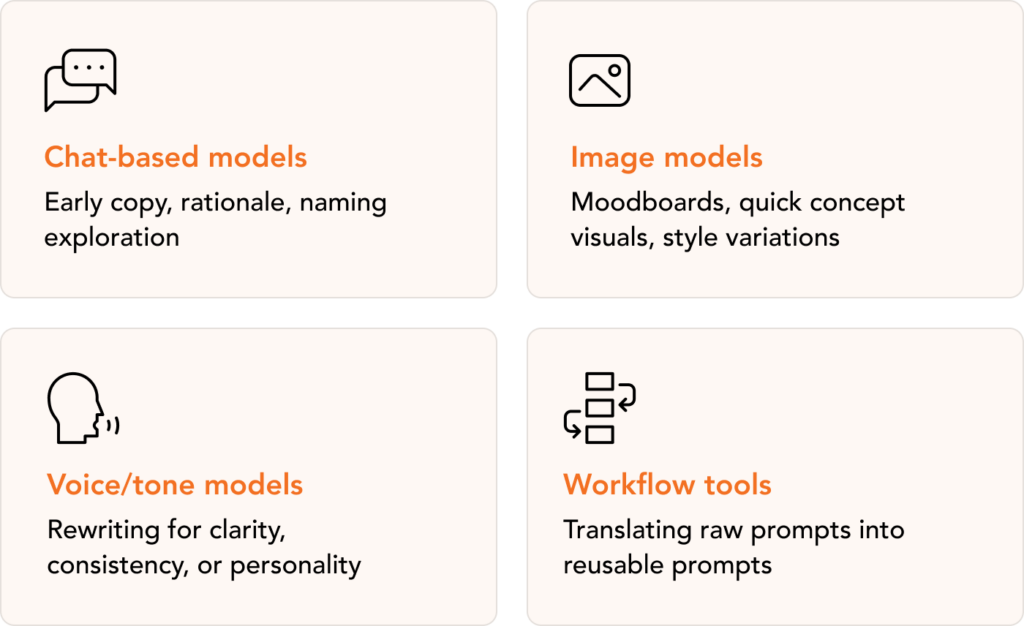
Think of this as: three tools per role, used predictably, documented clearly.
Agencies falter when creatives use 12 tools inconsistently.
They win when creatives use 3 tools consistently.
Skill 4—Creative Standards For AI Output
AI is fast.
But only creatives can define “good.”
Teams must learn to apply the same quality standards they use in traditional work:
- Does this align with the client’s strategy?
- Does this match the brand’s emotional range?
- Does this support the narrative arc of the campaign?
- Is this directionally correct or just “interesting”?
Skill 5—Presentation & Rationale
AI doesn’t replace strategy—it requires stronger strategy.
A trained creative can explain:
- Why a concept works
- How AI accelerated the exploration
- What part was AI-assisted vs. handcrafted
- Why one direction is stronger than the others
Clients trust this.
It feels senior.
It feels thoughtful.
It differentiates your agency instantly.
Part 3 – Design Predictable
Processes: The System That Turns AI
From Experimentation Into
Reliability
The most common mistake agencies make is assuming that once creatives have “the mindset” and “the skills,” AI will naturally become part of the workflow.
It won’t.
Creative teams don’t need more freedom with AI.
They need a process—so their best work becomes predictable, repeatable, and scalable.
That’s the third pillar of the C3M (Creative AI Confidence Model): Process Predictability.
Here’s how to build it.
The Before/After of Process Clarity
Before (No AI Process):
Creatives try AI randomly
- PMs can’t estimate workloads
- Deliverables don’t match expectations
- Revision loops multiply
- AI usage varies by person, not by project
- Leadership can’t measure impact
This leads to frustration on all sides.
After (Clear AI Process):
- Everyone knows when AI is used
- PMs estimate with confidence
- Creative leads review against consistent criteria
- AI exploration happens early, not late
- Final outputs feel more intentional
- Leadership sees measurable gains
This is how AI stops being “extra work” and becomes how you work.
A Simple, Stealable Workflow (The 6-Step Creative AI Cycle)
Here is a proven workflow you can apply tomorrow—no reorganization required.

1. Brief Alignment (Human)
Creative lead reviews the brief and identifies where AI will assist (not replace) work:
- Ideation
- Early copy
- Moodboards
- Concept alternatives
- Style directions
This prevents AI from drifting outside the project’s strategic guardrails.
2. AI Exploration Pass (Human → AI)
Creatives produce 2–3 rounds of structured AI exploration using the trained skills from Part 2.
Outputs may include:
- 12–20 headline variations
- 4–6 design directions
- 2–3 narrative arcs
- Visual moodboards
- UX variants
This accelerates the messy early phase without compromising direction.
3. Review & Filtering (Human)
Creative leads apply the agency’s standard of quality:
- Does this match our positioning?
- Is this directionally correct?
- Does this align with client strategy?
- Does this reflect their brand story?
AI does not filter. Senior creatives do.
4. Human Refinement (Human)
Using AI-accelerated drafts, creatives craft the real work:
- Polished copy
- Refined layouts
- Cleaned-up visuals
- Strategic narratives
- Presentation-ready options
This is where the agency’s originality shines.
5. Internal Review + Rationale (Human)
The creative lead ensures:
- What AI assisted
- What was human-led
- Why the chosen direction works
- How exploration informed the final
This improves client alignment and reduces back-and-forth.
6. Documentation For Reuse (Ops)
PM or creative ops captures:
- Prompts used
- What worked
- What didn’t
- Final variations
- Time saved
This creates a playbook, not a one-off attempt.
Assign AI Roles to Remove Ambiguity
When everyone owns everything, no one owns anything.
Assign roles:
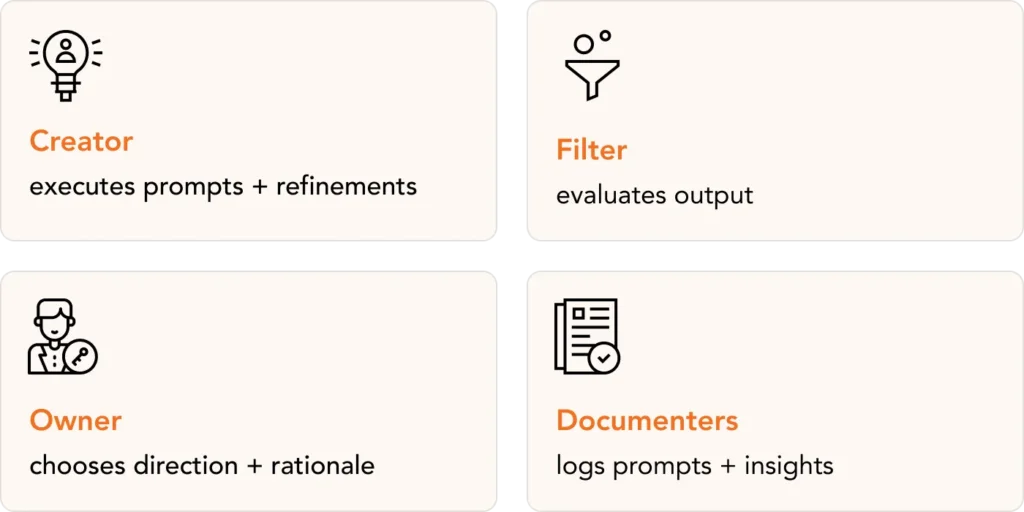
These roles can rotate—but they must be defined.
Clear roles eliminate friction and protect quality.
Metrics That Actually Matter (And Keep Your Team Accountable)
Leadership doesn’t need 20 KPIs.
Just track these four:
- Time saved in exploration
- Revision loops reduced
- Internal effort required
- Client approval speed
When these improve, margin improves.
When they decline, your workflow needs adjustment.
The Strategic Opportunity For Agencies: Where AI-Confident Creatives Give You An Edge Competitors Can’t Match
Every agency talks about “using AI.”
Very few can show clients what it means for the quality, speed, or clarity of the work.
That gap is your advantage.
Once your creative team leads AI—not just uses it—your agency unlocks a strategic layer competitors can’t copy by simply adding another tool.
Here’s what that looks like.
AI-Confident Creatives Strengthen Your Positioning In Pitches
Clients don’t want “AI capabilities.”
They want:
- Faster clarity
- Better options
- Stronger reasoning
- Tighter strategy
- More confidence in the creative direction
Here’s a scene every agency knows:
Before (Traditional Pitch Prep)
The team spends 5–7 days generating concepts, directions, and rationale. They’re exhausted before the pitch even begins. The deck is solid, but options feel limited.
After (AI-Led Concepting)
Day 1:
- 20 headline territories
- 6 visual language explorations
- 3 narrative arcs
- Moodboards with 10+ strategic angles
Day 2–3:
- The team filters, refines, and sharpens.
By Day 4, you have more—and better—strategic options than competitors who worked twice as long.
Pitch decks become deeper, tighter, and more confident—without burning out your team.
You Reduce Revision Loops And Improve Client Trust
Revisions destroy margin more than any other force.
AI-trained creatives cut those loops dramatically.
Example:
Before (Unclear Direction)
Client sees 1–2 concepts, isn’t sure, requests “just a few more.”
The team scrambles. Weeks slip. Morale drops.
After (AI-Assisted Exploration)
Client sees:
- 3 strategic directions
- 3 visual expressions per direction
- Clear rationale for each
- A documented thought process
Clients react with: “Now I see the direction we should go.”
Trust increases. Decisions speed up. Downstream chaos disappears.
This is where Agency Edge’s insight becomes real: clients reward clarity with budget and loyalty.
You Become Future-Proof Without Becoming Tool-Chasers
Most agencies will get stuck in “AI tool fatigue”:
every month a new tool, a new feature, a new hype wave.
But agencies who invest in creative leadership of AI, not tools, avoid this trap.
They win because:
- The team knows HOW to direct AI regardless of the tool
- Processes don’t break with every platform update
- Strategy remains stable even if execution tools change
- Creative taste still sits with the humans
You future-proof your agency by future-proofing your people—not your software list.
Your Creative Team Becomes A Differentiator, Not A Bottleneck
Most agencies unintentionally position their creative team as “the
department that slows things down.”
But with AI confidence:
- They concept faster
- They align with clients faster
- They refine faster
- They present stronger options
- They build rationale more clearly
- They reduce revisions
- They elevate the pitch
This shifts your agency’s internal narrative: Your creative team becomes an unfair advantage, not a constraint.
The Agencies That Win Will Have Creative Teams Who Lead AI, Not Chase It
Here’s the uncomfortable reality:
AI isn’t widening the gap between agencies—leadership clarity is.
The agencies that fall behind won’t fail because their creatives aren’t talented.
They’ll fail because their teams never learned how to use AI with structure, standards, and confidence.
Meanwhile, the agencies that invest in mindset, skills, and process will pull ahead—fast.
Creative teams who know how to lead AI:
- Reduce revision loops
- Produce sharper options
- Move upstream in strategy
- Pitch with more clarity
- Protect your margins
- Accelerate your timelines
- Strengthen client trust
This is no longer optional.
It’s a competitive necessity.
And the agencies who act now will build an advantage the market can feel immediately—in pitches, in delivery, and in retention.
AI doesn’t replace creative talent. It amplifies the ones who know how to lead it.
Stabilize Your Delivery While Your Creative Team Learns To Lead AI
Your team can’t learn AI in a vacuum.
They need time, space, and predictable delivery behind them—or training becomes another source of pressure instead of a strategic investment.
That’s where we come in.
While your creative team is building AI fluency, we stabilize your production load so nothing slips. We protect your timelines, maintain your quality, and give your team breathing room to learn without fear.
If you want a partner who keeps your delivery predictable while your team levels up, we’re built for that.
FAQs
Will AI Replace Our Creative Talent?
No. AI replaces execution, not creative judgment. The agencies losing ground aren’t losing talent—they’re losing clarity. When creatives learn to direct AI instead of compete with it, their value increases because clients pay for strategy, rationale, and taste, not machine output.
Where Do We Start If Our Team Is Already Overwhelmed?
Start with one workflow, not a full transformation. Pick something low-risk (like headline exploration or moodboards), define the expectation (“AI assists the first 20–30%”), and let the team practice with zero performance pressure. Momentum comes from containment, not scale.
How Long Until We See Real Impact From AI Training?
Most agencies see impact within 2–4 weeks—usually in the form of faster concepting, fewer revision loops, and clearer rationale. The real shift happens around the 6–8 week mark when prompting, iteration, and filtering become habits instead of experiments.
Is This Only For Larger Agencies With Big Resources?
No—small agencies usually adopt AI faster because they have fewer decision layers. With a simple model like C3M (Mindset → Skills → Process), even a 3-person creative team can become AI-confident in weeks, not months.
What If Our Clients Aren’t Asking About AI?
Clients rarely ask for AI directly. What they do ask for is:
- faster clarity
- stronger concepts
- tighter rationale
- fewer revisions
- more strategic thinking
AI-trained creatives deliver all of this. The value is felt, even if clients don’t mention AI by name
Do We Need A Dedicated AI Role Or Specialist?
Not at first. Most agencies see better results when existing creatives learn structured prompting, iteration control, and filtering. Only once patterns stabilize does it make sense to assign an AI owner or creative-ops partner to formalize the system.
Should We Worry About Quality Becoming “Too AI”?
Only if you let AI lead the work. When creatives direct AI—instead of outsourcing judgment to it—the work stays grounded in strategy, brand, and emotion. Quality issues come from lack of human filtering, not from AI itself.