AI Isn’t a Race—It’s a Sequence
Your clients expect you to “use AI.”
Your team worries what that means for their roles.
And every vendor is promising you the miracle workflow that will “future-proof” your agency.
That’s not clarity—that’s noise.
Here’s the real pressure point: You’re being asked to make AI decisions without a map, without the time, and without breaking delivery in the process.
This guide solves that.
This is a designed for agency owners who need to make margin-first, disruption-minimal decisions about AI—decisions that strengthen delivery instead of overwhelming their teams.
And it answers the only question that actually matters:
What should your agency prioritize right now—and what can you safely delay until later?
Because AI isn’t won by being early.
It’s won by sequencing the right capabilities in the right order—the ones that cut rework, stabilize margins, and protect your team from chaos.
By the end, you’ll have a clear, defensible, client-ready roadmap built on one principle:
AI isn’t a race.
It’s operational sequencing—and sequencing is where agencies win.
The Real Reason Agencies Need an AI Roadmap
Your world is getting louder.
Clients ask whether AI can “speed things up,” “cut costs,” or “make the work smarter.” Your team quietly wonders whether AI threatens their roles—even the high performers who shouldn’t be worried.
And every vendor is pitching a “transformational” workflow that looks great in a demo but collapses inside real agency operations.
Behind the noise sits the operational truth agency owners already know:
AI doesn’t replace strategists—it replaces rework.
And rework is where margins die.
That’s why agencies need an AI roadmap. Not to chase hype, but to:
- Reduce revision cycles
before they hit your senior team - Tighten briefs and QA
so small mistakes stop snowballing - Accelerate production
without compromising quality - Free people from busywork
so more attention goes to strategy and client value
Without a roadmap, AI becomes a drawer full of abandoned tools and half-finished pilots. With one, it becomes a force multiplier—predictable, repeatable, and aligned with how your agency already operates.
This is the shift most agencies never make. And it’s exactly where your roadmap starts.
Why Most Agency AI Plans Fail Before They Start
Most AI failures don’t happen in implementation.
They happen in the first planning meeting, the moment someone says:
“Let’s try this tool.”
That’s the moment the plan dies.
Because “tool-first” thinking creates the fastest path to wasted time, frustrated teams, and eroded margins.
Here’s where agency AI initiatives collapse:
They Start With Experimentation Instead of Impact.
Teams jump into playground mode—running prompts, testing plugins, benchmarking outputs—without connecting anything to workflow, delivery, or margin impact.
(For Alex: this is the exact definition of hidden cost.)
They Underestimate the Disruption Tax.
Every new AI adoption changes how people brief, review, QA, request revisions, and hand off work.
If the process isn’t updated first, AI actually adds friction instead of removing it.
They Chase Novelty Over Sequencing.
A shiny new model feels exciting… until you discover it adds three steps to the workflow instead of removing one.
They Skip Margin Math.
Agencies evaluate AI differently than they evaluate freelancers, PM tools, or retainer staffing. They look at the subscription cost—not the hidden cost of training, misalignment, or review cycles.
Here’s the operator-level reframe:
You don’t need more AI.
You need the right AI, deployed in the right order.
That’s the difference between agencies that gain efficiency
and agencies that end up drowning in unused tools and internal chaos.
Now let’s get clear about what actually drives AI success inside an agency.
What Actually Matters in an Agency AI Roadmap
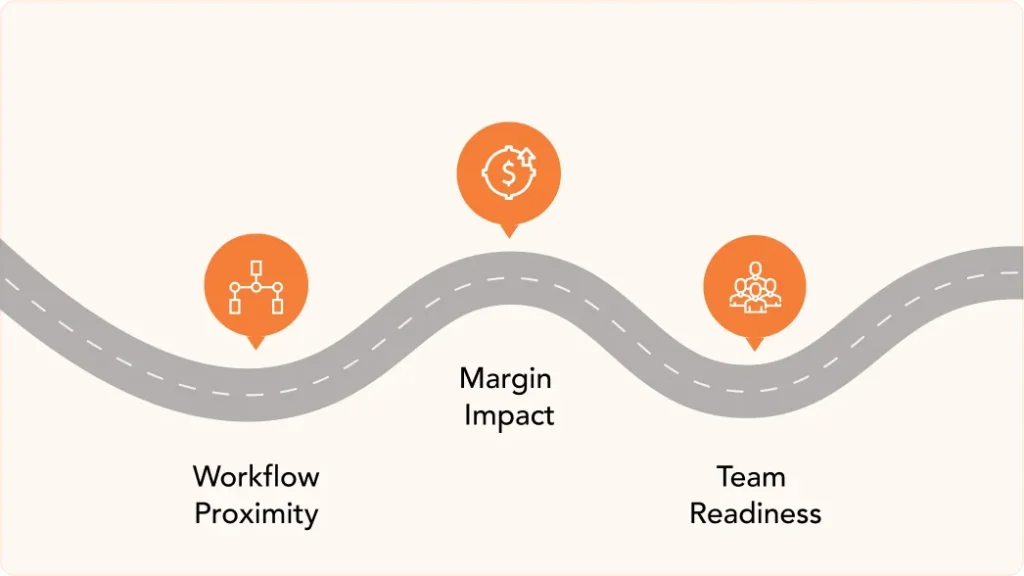
Every AI decision you make should pass through three filters.
If it doesn’t hit all three, it’s noise—no matter how impressive the demo.
Workflow Proximity
The closer AI sits to daily delivery, the faster the ROI.
Real examples:
- AI catching accessibility or metadata errors before they hit QA
- AI rewriting incomplete client inputs into usable briefs
- AI accelerating production tasks (resizing, renaming, scaffolding code, alt-text generation)
These aren’t futuristic.
They’re where agencies lose the most time—and where AI quietly returns it.
Margin Impact
AI must earn its keep, which means reducing:
- Rework
- Manual checks
- Context switching
- Delivery friction
- Low-value production work that interrupts senior talent
If margin impact is unclear, the tool is a distraction.
Impact → then adoption.
Team Readiness
The biggest AI cost isn’t the tool—it’s the cognitive load of changing how work gets done.
A smart roadmap meets your team where they are, not where LinkedIn thinks they should be.
If a workflow is messy or inconsistent today, AI won’t fix it—it will expose it.
When a use case hits all three filters (workflow proximity, margin impact, team readiness), AI becomes:
A multiplier, not a burden.
This is the foundation of White Label IQ’s AI Priority Matrix—the decision engine that anchors the entire roadmap.
Introducing White Label IQ’s AI Priority Matrix
Most agency leaders don’t struggle with AI ideas—they struggle with AI prioritization. Everyone has a list of tools they “should explore.”
Very few have a way to decide, in a leadership meeting, what deserves attention now and what belongs in the parking lot.
That’s why you need a decision engine at the center of your roadmap:
White Label IQ’s AI Priority Matrix
A simple but powerful 2×2 diagnostic that filters every AI idea through the only criteria that matter to an agency:
- X-axis: Margin Impact (Low → High)
- Y-axis: Operational Disruption (Low → High)
This matrix turns opinions into decisions.
Here’s how each quadrant works—with the clarity, examples, and use cases agencies actually need.
1. Prioritize Now
These are your first 60-day wins—high-value use cases that plug directly into existing workflows without breaking anything.
Examples:
- AI-assisted QA that catches basic errors before they hit senior review
- Brief cleanup and rewriting incomplete inputs into usable formats
- Production acceleration (resizing, renaming, code linting, metadata generation)
- Scope-accuracy checks that tighten assumptions and prevent rework
Agency impact:
Immediate reduction in revision cycles, fewer back-and-forths, faster delivery, and predictable margins.
This quadrant is where speed—and confidence—are built.
2. Pilot Carefully
This is where the value is real… but so is the risk of breaking delivery if you move too fast.
Examples:
- Workflow-integrated content pipelines
- Template-based code scaffolding
- Structured content generation for multi-output deliverables
- AI tied to dev/QA systems or ticketing platforms
Agency impact:
Big wins—but requires careful rollouts, training, SOP updates, and sequencing.
Rule:
Only move into this quadrant after your team has already succeeded with “Prioritize Now” use cases.
Don’t build automation on top of messy workflows.
3. Delay Until Needed
These tools feel innovative but don’t materially shift delivery or profitability.
Examples:
- Novelty plugins
- Light AI “assistants” that duplicate existing workflow steps
- Trend-driven features that sound useful but don’t touch production or QA
Agency impact:
Minimal. These are distractions until a proven use case emerges.
Rule:
If it doesn’t move margins, it doesn’t move up the roadmap.
4. Avoid Completely
This quadrant is dangerous—high-effort, high-risk, low-return.
Examples:
- Custom LLMs without proprietary data scale
- Over-engineered automation systems requiring heavy PM oversight
- Complex RPA or agent workflows detached from client delivery
- AI labs without a clear operational charter
Agency impact:
High disruption, low payoff, and guaranteed morale burn.
These can stall delivery, inflate cost, and destabilize teams.
Rule:
Only explore after the business case becomes undeniable—which is rare for most agencies.
How to Use the Priority Matrix in a Monday Meeting
Here’s the operational playbook agency leaders have been using with us:

- Step 1—List all AI ideas from the team, clients, vendors, or leadership. Throw everything into one backlog.
-
Step 2—Score each idea against three filters
- 1) Workflow Proximity
- 2) Margin Impact
- 3) Team Readiness
-
Step 3—Drop each idea into the quadrant it belongs.
No debate. No gut feeling. Just criteria → quadrant → decision. -
Step 4—Your roadmap emerges automatically.
- Do Now: Immediate execution
- Do Next: Structured pilot
- Do Later: Document and revisit
X Avoid: Remove from the roadmap entirely
-
Step 5—Revisit monthly
The matrix evolves as your workflows improve and your team becomes more AI-ready.
This is the tool that stops agencies from chasing shiny objects—and starts aligning AI to margin protection, delivery reality, and team bandwidth.
Your 3-Stage AI Roadmap: Do Now, Do Next, Do Later
An AI roadmap isn’t a vision document.
It’s an operational sequence—a way to adopt AI without breaking delivery, overwhelming your team, or exposing your margins to chaos.
Here’s the version built specifically for agencies—grounded in the Priority Matrix you just saw, and validated across real agency production workflows.
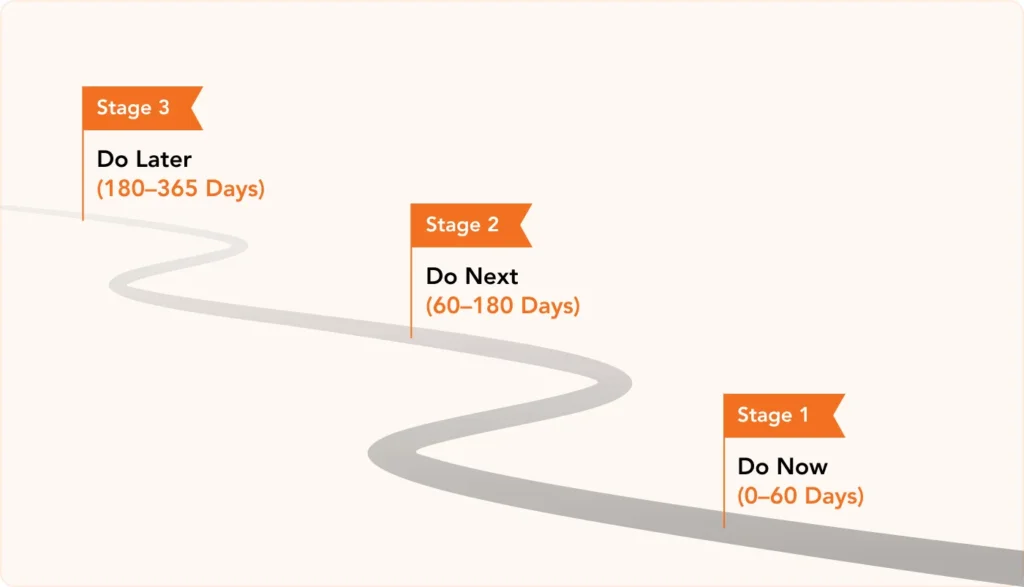
STAGE 1—DO NOW (0–60 Days)
High Impact → Low Disruption
This is where your first wins come from.
No workflow redesign. No process debates. Just friction removal.
1. AI-Assisted QA
Catch errors before they touch senior review.
Examples:
- Alt-text corrections
- Accessibility fixes
- Grammar/clarity adjustments
- Code linting for common dev issues
Why it matters:
These are the exact errors that create avoidable revision cycles—the biggest silent margin killer in every agency.
2. Brief Cleanup & Input Standardization
AI takes messy, incomplete client inputs and turns them into usable briefs.
Example:
Client sends a three-line email with missing requirements → AI reforms it into a structured brief with goals, deliverables, references, constraints, and questions.
Why it matters:
Your juniors stop spending 45 minutes deciphering an email, and your seniors stop correcting misaligned work later.
3. Production Acceleration
AI removes the tedious, manual tasks that drain hours from design, dev, and content teams.
Examples:
- Resizing image sets
- Renaming and organizing assets
- Converting alt-text metadata
- Generating CSS scaffolds
- Cleaning structured data
Why it matters:
Production becomes predictable—not dependent on who has the free 30 minutes to do “the small stuff.”
4. Scope Accuracy & Assumption Checks
AI helps refine assumptions, catch inconsistencies, and flag missing requirements before scopes go out.
Example:
You drop a rough scope draft into AI → it highlights contradictory timelines, missing dependencies, or unclear deliverables.
Why it matters:
Better scopes = fewer surprises, fewer scope fights, fewer margin leaks.
Stage 1 Summary:
Small changes, immediate wins, zero disruption.
Your team feels relief quickly—and that confidence fuels the next stage.
STAGE 2—DO NEXT (60–180 Days)
High Impact → Higher Disruption
Only begin here once Stage 1 wins are visible and the team trusts the process.
1. AI Reporting & Insight Generation
Turn raw performance data into client-ready insights.
Examples:
- Weekly summary dashboards
- KPI anomaly detection
- Narrative explanations for non-technical clients
- Automated segment-level insights from analytics
Why it matters:
Client conversations become proactive rather than reactive—without burning hours.
2. Workflow-Integrated AI
This is where AI becomes part of the delivery engine instead of an add-on.
Examples:
- Content pipelines that generate multiple asset variations
- Template-based code scaffolding for developers
- Structured content systems (FAQs, schema, product descriptions)
- Automated QA checks baked into dev/QA pipelines
Requirements:
- Updated SOPs
- Versioned prompts
- Review loops
- Clear ownership rules
Why it matters:
This creates meaningful throughput gains—but only if Stage 1 foundations exist.
3. Internal Training & Upskilling
Standardize how your team uses AI.
Examples:
- Role-specific prompt libraries
- Review criteria for AI-assisted outputs
- “Augmentation, not automation” training sessions
- Updated SOPs integrating AI as a step, not a replacement
Why it matters:
Your team evolves without losing confidence, quality, or internal trust.
Stage 2 Summary:
Here’s where AI becomes part of the workflow—not a side experiment.
This stage makes the agency visibly faster for clients.
STAGE 3—DO LATER (180–365 Days)
Low Impact or High Disruption
This is where most agencies start—and where most fail.
Not because the ideas are bad, but because they require strong foundations that most agencies don’t have yet.
1. Advanced Automation Systems
Multi-step workflow agents that manage entire processes.
Examples:
- Multi-stage content production
- Automated QA workflows
- Multi-system RPA across PM tools, DAMs, dev environments
Why it often fails:
Requires heavy PM oversight, clean SOPs, and deep team trust—conditions most agencies haven’t built yet.
2. Internal Knowledge Bases & SOP Systems
AI-curated internal wikis, auto-updating SOPs, etc.
Why it belongs later:
It only works after your processes are consistent, documented, and stable.
3. Model Fine-Tuning
Training models on proprietary assets.
Why it belongs later:
Only viable when you have high-volume, high-quality data, stable outputs, and strong QA systems.
4. Custom LLM Development
Costly, fragile, and rarely aligned with agency-scale needs.
Why agencies regret it:
You inherit the maintenance burden—and you never needed a custom model to achieve 95% of the operational wins anyway.
Stage 3 Summary:
These are optional—until the business case is undeniable.
Most agencies never need to go this far unless they’re scaling aggressively or building IP-heavy products.
How To Roll Out AI Without Breaking Your Team
AI doesn’t break agencies.
Change does.
And change only breaks teams when it arrives without clarity, sequencing, or psychological safety.
Rolling out AI isn’t a technical challenge—it’s a leadership challenge.
Here’s how agencies introduce AI without triggering fear, chaos, or cultural damage.
1. Start With Meaning, Not Mandates
Teams don’t resist AI—they resist ambiguity.
Uncertainty about roles, expectations, and performance standards creates silent friction long before any tool appears.
The easiest way to lower resistance is to make AI’s purpose unambiguous:
AI is here to remove unnecessary tasks, not replace necessary people.
What AI typically removes in agencies:
- Rework
- Manual QA loops
- Admin-heavy handoffs
- Revision churn
- Time lost deciphering incomplete briefs
- Repetitive production tasks that interrupt deeper work
When the purpose is framed as removing drag, not removing talent, teams understand AI as a support layer—not a threat.
That mental shift is the foundation for healthy adoption.
2. Train for Augmentation, Not Automation
Training fails when it’s framed as “teaching people to do less.”
It succeeds when it’s framed as equipping people to do their best work with fewer obstacles.
Across agencies, here’s the pattern:

Writers
use AI to tighten first drafts and explore variations faster.

Designers
use AI to eliminate repetitive prep work and asset formatting.

Developers
use AI to speed up scaffolding and catch routine errors earlier.

PMs
use AI to accelerate brief prep, meeting summaries, and QA checklists.
These upgrades don’t replace judgment, creativity, or stewardship—they amplify them.
AI becomes a professional accelerant, not a substitute for expertise.
When people see that AI gives them more time for the work they take pride in, their adoption becomes voluntary and enthusiastic.
3. Update Process Before You Update People
Many AI rollouts fail because the underlying workflow is inconsistent, undocumented, or dependent on tribal knowledge.
AI amplifies whatever process it enters—clarity or chaos.
The safest rollout sequence is:
- Clarify the workflow.
Define steps, handoffs, review points, and ownership.
Identify where work routinely stalls or where rework originates. - Insert AI into the clarified workflow.
Add automation and augmentation where the process is already stable. Never use AI to patch over a broken workflow. - Train people on the new process, then on the AI itself.
Training makes sense only when the workflow it supports is clear and consistent.
This order prevents accidental disruption and ensures that AI improves delivery instead of destabilizing it.
4. Roll Out in Public, Not in Secret
When leaders explore AI quietly, teams fill the gaps with speculation.
Silence becomes interpretation—and usually the wrong one.
Transparency defuses that dynamic.
How healthy AI rollouts look inside agencies (pattern-based):
- Leaders share what they’re testing, openly.
- Early drafts, prompts, and outputs are shown to the team without polish.
- Teams are invited to suggest use cases.
- Wins and misses are discussed openly.
- People are encouraged to experiment, document, and share.
Nothing signals stability more than leadership letting the team watch experiments happen in real time.
It normalizes learning, protects culture, and builds trust.
5. Protect Roles While Evolving Responsibilities
People aren’t afraid of AI.
They’re afraid of losing definition—not knowing whether their strengths still matter.
The antidote is clarity:
Roles stay secure. Responsibilities evolve upward.
Across agencies, here’s how roles typically shift:

Strategists
spend more time on decision-making, less on repetitive analysis.
Creatives
spend more time ideating and concepting, less on mechanical production.
Developers
move toward architecture and problem-solving, away from repetitive scaffolding.
PMs
become communication and alignment engines supported by AI-generated briefs, recaps, and checklists.
These shifts don’t shrink roles—they expand them.
People become more valuable, not less.
When teams understand the upward trajectory of their responsibilities, AI adoption becomes a path to relevance, not a threat to it.
When AI rollout is meaningful, transparent, sequenced, and tied to real process improvement, teams don’t resist it—they accelerate it.
That psychological safety is what turns AI adoption from a technical upgrade into a long-term competitive advantage.
Try the AI Priority Diagnostic
Your agency doesn’t need a stack of AI tools—it needs clarity on the right few.
The AI Priority Diagnostic gives you a margin-first, disruption-aware evaluation of where AI will make the largest immediate impact on your delivery model. In under 48 hours, you get a clear sequencing plan built around your workflows, your team’s readiness, and your operational realities—not generic advice or tool lists.
You’ll walk away with:
- Your top-priority AI opportunities
- A 90-day sequenced roadmap
- Margin-impact scoring for each use case
- Low-disruption quick wins your team can apply immediately
If you want AI to create relief—not rework—start with a diagnostic designed for agencies, not vendors.
FAQs: Building Your Agency’s AI Roadmap
FAQs
What Should Agencies Prioritize First When Building an AI Roadmap?
Start with high-impact, low-disruption AI use cases: QA checks, brief cleanup, revision reduction, scope accuracy, and production acceleration. These touch daily workflows, deliver immediate margin protection, and build team confidence before moving into deeper AI integrations. Early wins reduce hesitation and create the stability required for later automation.
How Can Agencies Tell Which AI Tools Will Actually Improve Margins?
Evaluate every tool through three filters: workflow proximity, margin impact, and team readiness. If a tool doesn’t reduce rework, shorten delivery cycles, or eliminate manual steps, it won’t meaningfully protect margins. prioritize AI that integrates into existing workflows and directly strengthens production, QA, or scoping accuracy.
Why Do AI Initiatives Fail Inside Agencies?
Most failures come from tool-first adoption, unclear workflows, and skipping sequencing. Agencies test tools without evaluating disruption costs, workflow fit, or training needs. Without a roadmap, AI turns into fragmented experiments. With sequencing and process clarity, AI becomes a predictable efficiency layer instead of an operational risk.
What AI Capabilities Should Agencies Delay or Avoid?
Delay or avoid high-disruption, low-impact initiatives like custom LLMs, overbuilt automation systems, complex RPA, or AI labs detached from client delivery. These require significant process maturity and ongoing maintenance. Agencies should explore them only after foundational workflows are stable and early AI wins are fully embedded.
How Does an AI Roadmap Reduce Team Workload and Client Pressure?
A roadmap clarifies what AI will eliminate and when—rework, QA cycles, admin tasks, and low-value production steps. This reduces internal stress, stabilises delivery timelines, and creates more predictable outcomes for clients. The result: fewer escalations, fewer surprises, and a healthier workload distribution across the team.