The Real Reason Clients Don’t Trust Your AI Services (And Why They’re Right to Slow You Down)
If you’ve tried selling AI-led work to risk-averse clients this year, you’ve already felt it: a sudden, suffocating hesitation.
Not curiosity.
Not confusion.
Distrust.
Legal wants another review.
Compliance wants a meeting.
Marketing wants “clarity on the workflow.” Approvals crawl. Every AI conversation turns into a defensive negotiation.
Agencies often assume this hesitation is fear of new technology. It’s not.
Clients aren’t afraid of AI. They’re afraid of becoming the next headline.
And for the past 18 months, the headlines have been brutal:
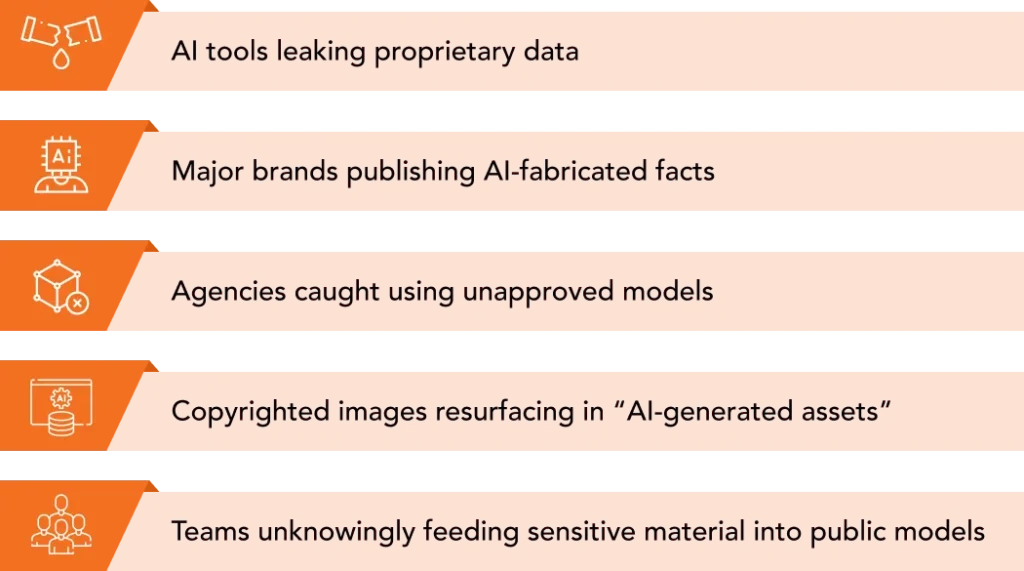
Executives took notes. Compliance teams built checklists.
And suddenly, even a harmless AI-assisted task started to look like a potential liability.
Here’s the truth agencies don’t say out loud:
Your clients don’t think you’re reckless—
they think you’re running parts of your workflow they can’t see.
And when a risk-averse brand can’t see your guardrails, they assume you don’t have any.
Their fear isn’t emotional.
It isn’t theoretical.
It’s operational.

This is the trust gap that’s choking AI adoption in 2025.
And until you close that gap—until you prove that your AI use is controlled, documented, reviewed, secured, and repeatable—your most conservative clients will continue saying:
“Not yet.”
“Not for this project.”
“Not until legal approves it.”
The agencies winning AI revenue right now aren’t the ones shouting about tools, speed, or model upgrades.
They’re the ones who show their receipts.
They’re the ones who prove control, not promise it.
They’re the ones who make their AI process as transparent and trustworthy as their human one.
This blog is going to show you exactly how to do that.
Not with hype.
Not with vague assurances.
Not with tech jargon.
But with a 3-pillar AI Trust Framework you can put in front of any risk-averse client—and instantly lower the temperature in the room.
By the time you’re done reading this piece, you’ll know:
- The psychology behind client AI hesitation
- Why traditional “don’t worry, we review everything” scripts fail
- How top agencies make their AI workflows provably safe
- What guardrails risk-averse brands expect — non-negotiably
- How to win approvals faster without diluting your AI efficiency
- And How White Label IQ helps agencies scale AI-led work without ever becoming a liability to their clients
If you sell AI-led services in 2025, this framework isn’t optional.
It’s the new prerequisite for trust.
Let’s rebuild that trust—one clear, documented guardrail at a time.
Why AI Feels Riskier in 2025: The New Client Fear Landscape
The biggest mistake agencies make is assuming clients view AI through the same lens we do—productivity, acceleration, efficiency.
They don’t.
They view AI through the lens of potential damage.
And in 2025, that damage feels closer, more realistic, and more expensive than ever.
Risk-averse brands aren’t reacting to hype.
They’re reacting to real institutional pressure—regulatory, legal,
operational, and reputational.
Four forces have completely reshaped how clients judge AI use today:
Regulatory Pressure Has Hit a Breaking Point
Two years ago, most brands didn’t have AI policies. Today, even mid-market companies behave like global enterprises.
Compliance teams now expect:
- Disclosure of every AI touchpoint
- Data-flow documentation
- Approved model lists
- Proof of sandboxed environments
- Non-negotiable bans on public model data exposure
If you don’t provide this upfront, you lose trust before the work even begins.
Public AI Failures Have Made “Corporate PTSD” a Real Thing
Every time a brand releases AI-fabricated data, misuses copyrighted imagery, or leaks proprietary content into a model, every other brand quietly thinks:
“That could’ve been us.”
Executives overcorrect.
Legal teams clamp down.
Marketing becomes hypersensitive to risk.
This isn’t paranoia—it’s pattern recognition.
IP Ownership Is Now a Board-Level Concern
Five years ago, asset ownership was a creative department detail.
Now it’s a legal and financial risk.
Boards want answers to questions like:
- “Do we own what the AI helped generate?”
- “Could a model reuse someone else’s copyrighted content?”
- “Can we defend this output in a legal dispute?”
If your agency can’t confidently answer “yes,” your AI work is dead on arrival.
Shadow AI is the New Organizational Nightmare
Brands fear the things they don’t know you are doing.
A single line of unapproved prompting can create:
- Unverifiable outputs
- Data contamination
- Irreparable compliance violations
- Assets they can’t legally publish
Shadow AI kills trust instantly—sometimes permanently.
The Result: Clients Aren’t Anti-AI. They’re Anti-Uncontrolled AI.
From their perspective, AI isn’t unsafe.
Your opaque workflow is.
This is the landscape you’re selling into.
And unless you can show clients your guardrails visually, confidently, and proactively, they will continue to stall your AI initiatives—not because they don’t want the upside, but because they refuse the unbounded risk.
This sets the stage for the shift agencies must make next.
Reframing Safety: AI Doesn’t Need to Be Trusted—Your Process Does
Here’s the mindset shift that separates agencies winning AI approvals from those losing momentum:
Clients aren’t evaluating AI.
They’re evaluating your judgment.
They don’t care about the model you chose.
They care whether you can prove you used it responsibly.
They don’t care that AI “helped with research.”
They care whether a human verified every fact.
They don’t care that AI “accelerates drafts.”
They care whether brand voice, claims, and compliance were protected.
Risk-averse brands aren’t skeptical of AI capability.
They’re skeptical of AI chaos—the version of AI use with no boundaries, no logs, no review steps, and no transparency.
And this is where most agencies lose trust without realizing it:
- They talk about outputs instead of guardrails.
- They describe benefits instead of controls.
- They mention speed instead of safety.
- They hide their workflow instead of mapping it visually.
- They reassure rather than demonstrate.
Here’s the truth risk-averse clients already believe: If they can’t see your process, it doesn’t exist.
So yes—AI doesn’t need to be trusted.
Your workflow does.
Visibility lowers fear.
Documentation creates confidence.
Human checkpoints create accountability.
Audit trails create defensibility.
And when clients finally understand:
- Where AI is used
- Where AI is not used
- Where humans intervene
- What gets reviewed
- How accuracy is verified
- How data is protected
their anxiety collapses.
Suddenly you’re not “an agency using AI.” You’re “an agency that controls AI.”
That distinction is everything.
It’s the difference between slow approvals and fast ones.
Between skepticism and confidence.
Between stalled pilots and scalable AI revenue.
Introducing White Label IQ’s AI Trust Framework
Every agency is sprinting toward AI adoption.
But only a handful are building the governance clients now demand.
Risk-averse brands don’t buy AI capability.
They buy proof of AI control.
That’s exactly why we built the White Label IQ AI Trust Framework—a structured, repeatable, client-safe system that makes your AI workflow visible, verifiable, and fully accountable.
This framework does one thing better than anything else on the market:
It turns uncertainty—the biggest obstacle to AI approvals—into clarity.
Your clients will finally understand:
- What AI will do
- What AI will never do
- Where humans supervise
- How brand voice is enforced
- How accuracy is validated
- How data stays secure
- How every step is documented
And because this framework is designed specifically for agency workflows—creative, content, dev, QA, strategy—it fits naturally into the work you’re already doing.
The framework rests on three non-negotiable pillars that risk-averse clients require before they approve a single AI-assisted deliverable:
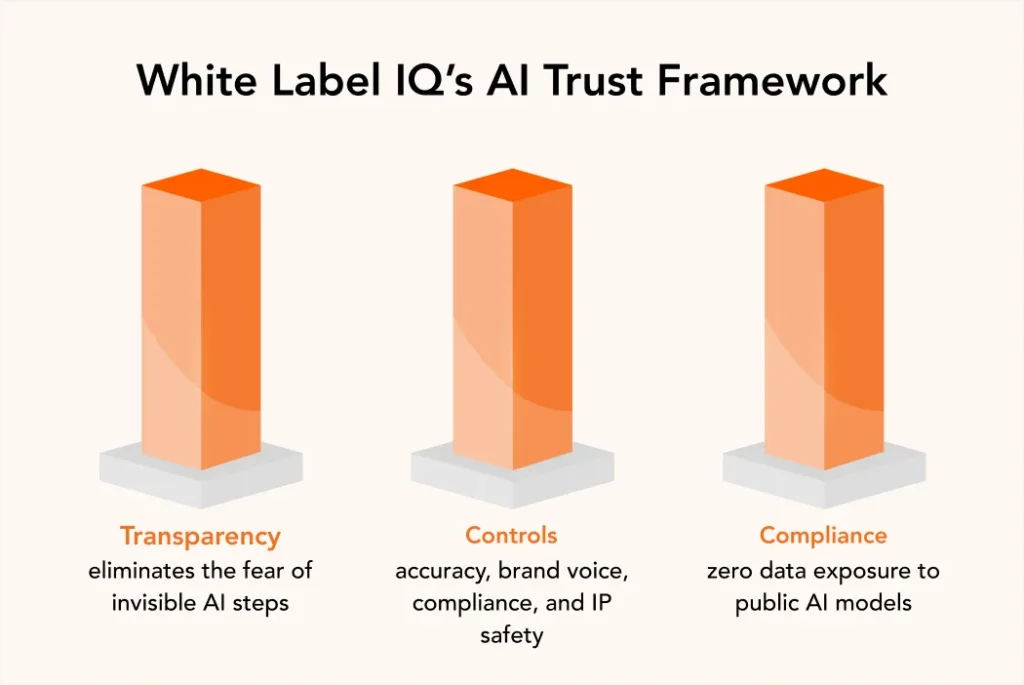
Pillar 1—Transparency
Clients see exactly where AI fits into your workflow, which tools you use, how data flows, and what boundaries are in place.
This eliminates suspicion and removes the fear of “invisible AI steps.”
Pillar 2—Controls
Every AI-assisted action is supervised by human specialists.
Accuracy, tone, compliance, brand voice, legal language, and IP validity are all reviewed before anything reaches the client.
This eliminates the fear of hallucinations, bias, copyright overlap, and rogue outputs.
Pillar 3—Compliance
Data never enters public models.
Secure or sandboxed environments are mandatory.
IP ownership is documented.
Audit trails are maintained.
Prompt governance is versioned and traceable.
This eliminates the legal, privacy, and brand-safety fears that keep executives up at night.
This is not a concept.
Not a philosophy.
Not a vague reassurance.
It’s a practical, client-ready trust engine.
When you present this framework, you’re not pitching AI.
You’re demonstrating risk management.
You’re showing leadership.
You’re proving maturity.
You’re giving clients something they rarely get from agencies:
a sense of safety.
And in 2025, safety—not speed—is what closes AI deals.
Transparency—What Clients Need to See Before They Approve Anything
Risk-averse clients don’t trust what they can’t see.
And right now, most agencies make their AI use look like a black box.
That is the fastest way to tank trust.
Transparency is the first and most important pillar of AI safety—because it removes the invisible risk clients assume you’re creating behind the scenes.
When a brand understands exactly how you use AI (and how you don’t), the anxiety evaporates. Their mental model shifts from “Are they taking shortcuts?” to “This is a disciplined workflow.”
Here’s what world-class transparency looks like in practice:
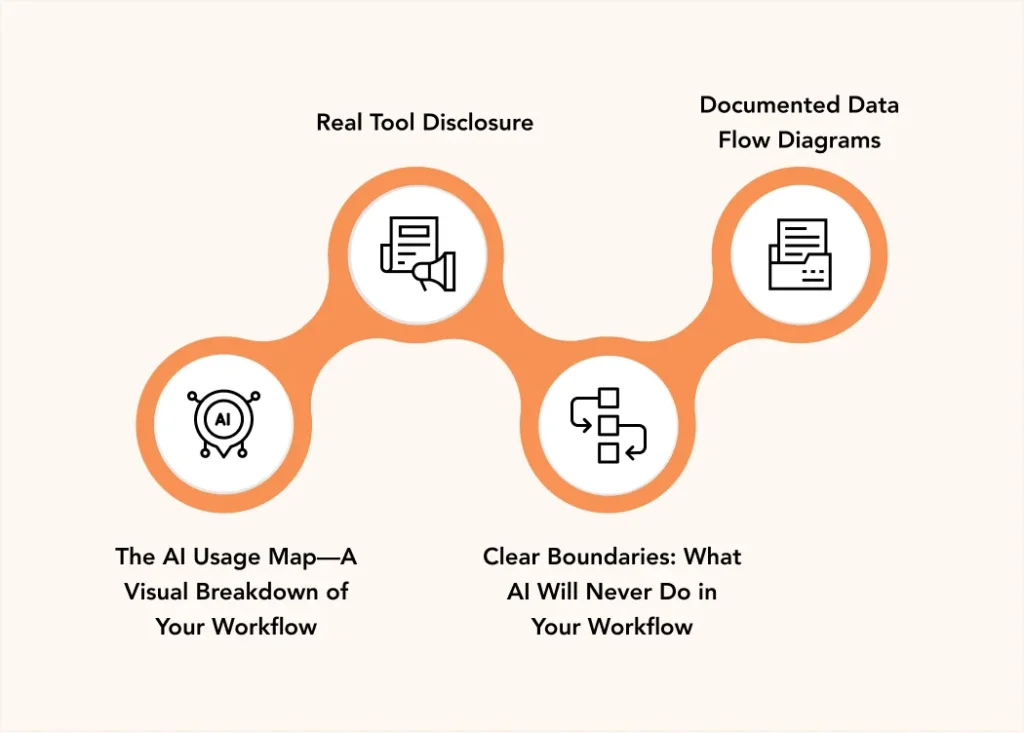
1. The AI Usage Map—A Visual Breakdown of Your Workflow
This is the single most powerful transparency tool you can offer.
You should be able to hand clients a one-page map showing:
Where AI helps (idea generation, research acceleration, QA suggestions)
Where humans take over (fact-checking, editing, compliance validation)
What AI is not allowed to do (final deliverables, legal-sensitive edits, brand voice signoff)
This removes the fear of “Does AI touch everything?”
Now they can see exactly where it fits—and where it doesn’t.
2. Real Tool Disclosure (Not the Vague, Glossed-Over Version)
Clients aren’t looking for your secret sauce.
They’re looking for safety signals.
Your AI stack should be clearly documented:
- The models you use
- The version numbers
- Whether they’re public, private, or sandboxed
- What data flows into them
- How team access is controlled
This satisfies compliance teams instantly.
A single slide labeled “Approved AI Stack” often accomplishes what two months of reassurance calls cannot.
3. Clear Boundaries: What AI Will Never Do in Your Workflow
This is one of the most trust-boosting lines you can deliver:
“AI never produces final client-facing deliverables without full human review.”
But you can go further:
- AI never writes legal claims
- AI never determines final strategy direction
- AI never edits compliance-sensitive content
- AI never bypasses brand voice checks
- AI never receives raw client data in a public environment
When you tell clients what AI cannot touch, they stop assuming the worst.
4. Documented Data Flow Diagrams
Show clients exactly where their data lives:
- What goes into the model
- What stays internal
- What is anonymized
- What never leaves your environment
- What is logged for audit tracking
This is not optional in 2025.
This is the new price of entry.
Transparency isn’t about oversharing.
It’s about showing clients that your AI use is visible, predictable, and governed.
Trust increases in direct proportion to clarity.
Controls—The Human-Led Guardrails That Keep AI Safe and Accurate
AI can draft, suggest, analyze, and accelerate.
But only humans can:
- Verify
- Contextualize
- Interpret
- Refine
- Approve
Risk-averse brands need proof that humans—not AI—own the final judgment call.
Controls are the backbone of that assurance.
Most agencies say “We review everything,” but can’t show how or when.
That’s why clients still say no.
Here’s what real, defensible AI control looks like:
1. Human-in-the-Loop (HITL) at Every AI Touchpoint
Every AI-assisted step must have a designated human reviewer.
Not vague. Not implied.
Explicit.
A senior strategist, copy editor, designer, developer, or QA lead checks:
- Factual accuracy
- Strategic logic
- Tone and brand voice
- IP compliance
- Legal-sensitive language
- Alignment with objectives
- Potential bias
AI accelerates the work.
Humans make it safe.
This is the difference between “AI-generated” and AI-supervised.
2. Multi-Layer QA—Not Just a Final Check
AI errors are sneaky.
They show up in:
- Numbers
- Claims
- Citations
- Tone
- Contextual understanding
- Placeholder logic
- Copyright patterns
A single “final review” won’t catch everything.
Agencies leading the field now apply multi-layer control:
Layer 1: Factual verification
Layer 2: Brand voice and style enforcement
Layer 3: IP and trademark safety review
Layer 4: Bias and inclusivity scan
Layer 5: Final human signoff
This is how agencies prevent hallucinations from making it into deliverables.
3. Prompt Governance & Version Control
This is the next major trust battleground—and the one almost no agencies implement properly.
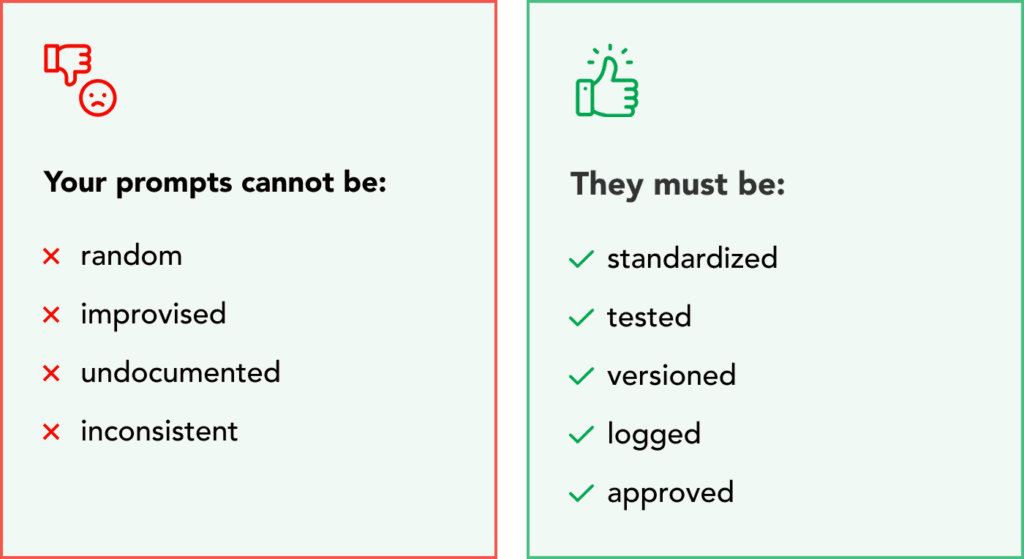
Risk-averse clients want to know that you don’t “just ask the AI” whatever you feel like that day.
They want a repeatable, defensible system.
4. Model Selection Justification
Brands don’t care which model you use.
They care why you chose it.
You must be able to articulate:
- Why this model is safer
- Why its outputs are more stable
- How it handles data
- What constraints or safety layers it applies
This transforms your agency from “AI user” to “AI operator”—a crucial distinction for enterprise-level trust.
Controls turn AI from a liability into a strength.
They turn your workflow from a risk into a competitive advantage.
Compliance—Protecting Data, IP, and Brand Reputation
If transparency calms clients—and controls reassure them—compliance is what finally gets legal teams to sign off.
Compliance isn’t a checkbox.
It’s a defensibility strategy.
It’s how you show brands that your AI use is not just efficient—but safe, lawful, and fully auditable.
Risk-averse clients care about three things more than anything else:
X No data exposure
X No copyright traps
X No regulatory surprises
Here’s how you demonstrate ironclad compliance:
1. Zero Data Exposure to Public AI Models
This is the one line that can instantly unlock AI approvals:
“None of your data ever touches public AI models. Ever.”
This includes:
- Raw brand files
- Customer information
- Internal documents
- Strategy decks
- APIs
- Proprietary workflows
If an agency cannot commit to this, enterprise clients walk away immediately.
2. Secure or Sandboxed AI Environments

3. Full IP Protection and Copyright Safety
Clients worry about one question more than anything else:
“Do we legally own what your AI helped produce?”
You must protect them with:
- Human-controlled source inputs
- Licensed reference assets
- No copyrighted training data contamination
- Documented ownership chains
- Metadata tracking for every deliverable
If you can’t prove IP validity, nothing else matters.
4. Audit Trails, Logs, and Documentation
You need traceability.
That means:
- Prompt logs
- Output review records
- QA checklists
- Model justification notes
- Version histories
- Data flow documentation
This is what legal teams want.
This is what compliance teams expect.
This is what risk-averse clients need before they approve AI-assisted work.
Compliance is not about fear.
It’s about defensibility.
It gives clients the confidence that no matter what happens—regulatory changes, legal challenges, or brand scrutiny—you’ve built a system they can rely on without hesitation.
Unsafe AI vs. Safe AI—What Risk-
Averse Clients Actually Need to See
Most client hesitation isn’t about AI capability.
It’s about AI workflow uncertainty.
When a client says, “We’re not sure about using AI yet,” what they really mean is:
“We don’t know if this process is controllable, defensible, or safe for our brand.”
Agencies often respond with generalized reassurance (“Don’t worry, we review everything”). But reassurance isn’t proof.
Risk-averse brands need a clear, visual distinction between AI chaos and AI governance—between the nightmare scenario they fear and the disciplined workflow they can approve.
Here’s the difference:
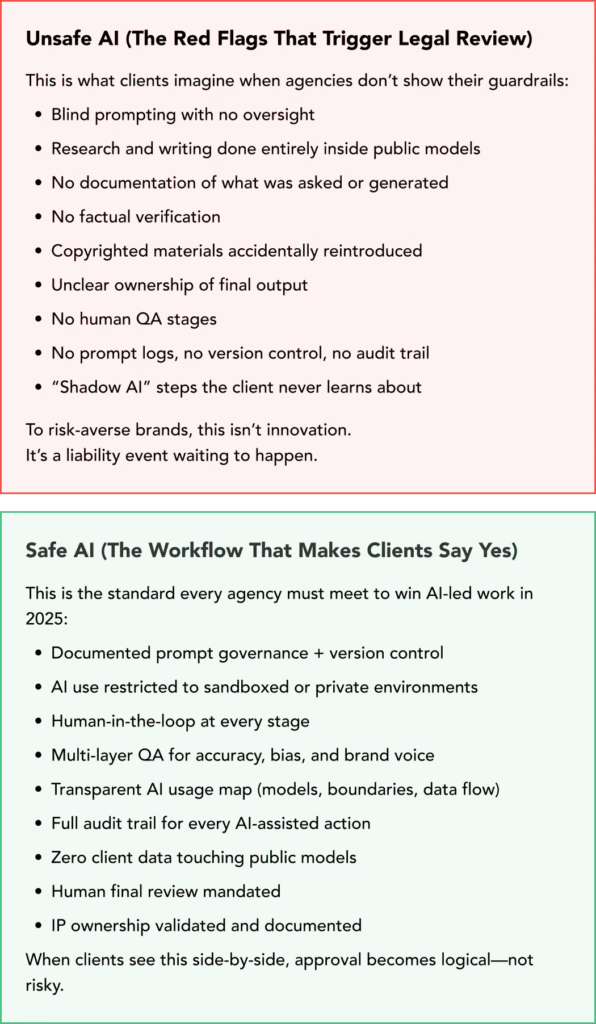
This makes the decision simple because it reframes AI from a danger to a controlled, auditable system.
This is the clarity most agencies never provide.
This is the clarity that wins enterprise trust.
White Label IQ’s AI Trust Checklist
(Client-Forward Toolkit)
Risk-averse brands want predictability above everything.
They don’t want enthusiasm.
They don’t want hype.
They don’t want vague process summaries.
They want proof that your AI workflow won’t expose them to unnecessary risk.
This checklist gives clients exactly that:
a structured set of questions that reveals whether an agency actually operates AI responsibly—or if they’re improvising.
Agencies who can answer these confidently win work.
Agencies who can’t lose it.
White Label IQ’s AI Trust Checklist
A client-ready tool clients can use in any AI conversation.
Ask your agency:
-
Which parts of your workflow use AI, and for what purpose?
(Show me the map. No black boxes.) -
Where do humans intervene—and what exactly do they check?
(Accuracy? Tone? Legal language? IP compliance?) -
What steps ensure the AI-generated content is accurate, safe, and brand-aligned?
(Explain your QA layers.) -
Which AI models and tools do you use—and are they public, private, or sandboxed?
(List them. Version numbers included.) -
How do you guarantee our data never enters public AI environments?
(Show the containment model.) -
What documentation or audit trail can you provide if needed?
(Prompts, logs, version history, reviews.) -
How do you ensure the final deliverable is human-validated and legally defensible?
(No final output should bypass human control.)
This checklist does three things instantly:
- It elevates the conversation
- It positions the agency as credible and responsible
- It exposes agencies who haven’t built real guardrails
The Scripts: How to Respond When
Clients Push Back on AI
Risk-averse clients rarely push back on AI itself.
They push back on uncertainty.
These operator-tested scripts neutralize fear immediately—not because they sound good, but because they’re backed by the guardrails you’ve now shown them.
Use these in meetings, proposals, and email conversations. They shift the tone from defensive to confident, from “trust us” to “here’s proof.”
“We never use AI without full human oversight.”
Why it works: It reframes AI as an assistant—not an autonomous decision-maker.
Follow with:
“Our specialists verify accuracy, brand voice, compliance, and IP safety before anything is delivered.”
“None of your data ever touches public AI models.”
Why it works: This eliminates the biggest enterprise-level objection in one sentence.
Follow with:
“We operate exclusively in private or sandboxed environments with strict access controls.”
“AI speeds up early-stage work. Humans finalize everything.”
Why it works: Clients are comfortable with speed; they are uncomfortable with automation owning decisions.
Follow with:
“You always receive human-crafted, human-reviewed deliverables.”
“We can show you exactly where AI is used and where it is not.”
Why it works: Visibility creates trust.
Follow with:
“Our AI Usage Map makes the process completely transparent.”
“Every AI output goes through accuracy, bias, and legal checks.”
Why it works: It proves you’re not relying on the model to be perfect.
Follow with:
“We have multi-layer QA specifically built for AI-assisted work.”
“We maintain full audit trails—prompts, versions, reviews, and decisions.”
Why it works: Why it works: Compliance teams love traceability.
Follow with:
“Nothing happens in our workflow without documentation.”
These scripts don’t reassure—they neutralize.
They’re not promises—they’re backed by the framework you now operate with.
This is how you win trust from risk-averse clients.
This is how you protect your agency from AI-related liabilities.
This is how you scale AI-led services without friction.
The New Agency Differentiator:
Showing Your Work
The agencies winning in 2025 aren’t the ones shouting the loudest about AI.
They’re the ones who can walk into a room and demonstrate control.
They’re the ones who don’t just say, “We use AI responsibly,” but can prove it step by step.
They’re the ones who turn a risk-averse client’s biggest fears—data exposure, brand safety, IP uncertainty—into strengths.
Because here’s the quiet truth most agencies ignore:
Clients don’t fear AI. They fear inconsistent process.
Fix the process, and you eliminate the fear.
When you show clients your AI usage map, your human-in-the-loop checkpoints, your compliance safeguards, and your audit trails, something powerful happens:
The energy in the room shifts.
Approvals accelerate.
Legal stops blocking progress.
Executives stop hesitating.
Your AI-led services stop being “risky” and start being “responsibly innovative.”
This is exactly where White Label IQ gives agencies an unfair advantage.
Long before AI enters the picture, White Label IQ partners already operate with:
- fixed scopes and predictable delivery
- accurate quoting and accountable execution
- AM/PM coverage for consistency
- disciplined cross-team workflows
- mature QA and data governance practices
In other words: the conditions AI requires to be safe.
White Label IQ doesn’t just help agencies adopt AI.
We help agencies adopt AI without ever becoming a liability to their clients.
And in today’s environment, that difference is everything.
Relief comes from clarity.
Trust comes from control.
AI becomes safe the moment your process becomes visible.
FAQs
1. How can agencies quickly build client trust in AI services?
Trust doesn’t come from promising accuracy or talking up your tools. It comes from showing clients exactly how your AI workflow works.
The fastest path to trust is:
- A clear AI Usage Map (where AI is used, where humans intervene)
- Documented guardrails (model selection, version control, prompt standards)
- Human-in-the-loop review at every stage
- Zero data exposure to public models
- A transparent data-flow diagram
- Multi-layer QA for accuracy, brand voice, and compliance
When clients see the full system, AI stops looking risky and starts looking responsible.
Most agencies explain AI. You need to prove AI is controlled.
2. What reduces the risk of AI errors, hallucinations, or misinformation?
Two things eliminate hallucination risk:
1. Human-in-the-loop review
Every AI-assisted output must be validated by a strategist, editor, QA specialist, or domain expert. Humans check:
- facts
- numbers
- legal-sensitive claims
- tone and voice
- source validity
- brand alignment
2. Multi-layer QA audits
The strongest agencies use layered QA, not a single “final review.” This includes:
- Factual verification
- Bias detection
- IP/trademark safety checks
- Brand voice enforcement
- Legal/compliance review
Hallucinations happen when teams assume the model is right. They disappear when AI becomes an assistant, not an authority.
3. How can agencies safely use AI with client data?
Safely = no client data ever enters a public model.
Enterprise brands require absolute containment. That means:
- Private or sandboxed AI environments
- Encrypted storage and access controls
- Clear data-flow documentation
- No uploading brand files to ChatGPT, Claude, Gemini, or any public model
- Logs for every AI interaction
- Internal-only processing for sensitive content
This is non-negotiable for risk-averse clients.
If you can’t guarantee data isolation, you can’t offer enterprise-grade AI.
4. What do risk-averse brands need before approving AI work?
They need evidence—not enthusiasm.
Specifically:
- Transparency: A documented workflow showing every step where AI is used
- Controls: Proof of human QA, checkpoints, review roles, and version control
- Compliance: Confirmation that data stays contained and outputs are IP-safe
- Auditability: Prompt logs, review records, and defensible documentation
- Boundaries: Clear statements of what AI will never do
When these elements are presented upfront, approval times drop dramatically. When they’re missing, AI conversations move straight into legal limbo.
5. What makes an AI workflow “brand-safe”?
A brand-safe AI workflow protects the three things executives care about most:
1. Legal Safety
- No unlicensed images
- No copyrighted data contamination
- Documented IP ownership for all outputs
- Logs proving prompt + model usage
2. Compliance Safety
- Strict data controls
- Private or sandboxed AI environments
- Versioned prompt governance
- Review history for every deliverable
3. Brand Reputation Safety
- Human editing for tone, claims, positioning
- Bias and inclusivity checks
- Consistent voice, style, and message integrity
- Multi-layer human QA
Brand-safe AI isn’t about avoiding AI—it’s about making AI defensible.