When Accessibility Stops Being Abstract
For years, ADA website accessibility has lived in an uncomfortable gray zone for agencies. Everyone has heard about it. Few have felt urgency. Most assumed it was a future problem—or a legal issue that ultimately belonged to the client.
That assumption breaks down in April 2026.
At that point, DOJ enforcement of the Title II rule becomes real for state and local government digital services. And when enforcement becomes real, accessibility stops being an abstract standard and turns into a delivery problem that lands squarely on the agency.
This deadline is not about checklists or compliance theory—it’s about whether your agency can absorb the operational shock when public sector sites are suddenly non-negotiable.
Public sector websites are rarely clean builds. They’re inherited. Layered. Built on fragile CMS templates, legacy components, and years of unexamined assumptions. When accessibility is addressed late, agencies don’t just fix issues—they absorb scope confusion, timeline compression, and client frustration.
This guide is written for agencies managing those realities. Not to explain the law in legal language. But to show where accessibility actually breaks inside delivery systems—and what happens when agencies wait too long to take ownership.
Because by April 2026, waiting is no longer neutral. It’s a risk decision.
Make Accessibility a Strategic Advantage—Before It Costs You
If your agency manages public sector or compliance sensitive websites, accessibility can no longer stay in the background. White Label IQ offers a white label ADA and accessibility audit built specifically for agencies that need clarity, speed, and defensible documentation before clients start asking hard questions.
Our WCAG 2.1 Level AA audits go beyond automated scans. We review templates, components, content patterns, and CMS constraints to surface the issues that actually create delivery risk. You receive a clear findings report, prioritized remediation guidance, and client ready documentation you can present under your own brand.
This is not about checking a box. It is about protecting scope, timelines, and trust before urgency collapses planning.
Agencies that lead with audits control the conversation. Agencies that wait inherit panic.
If you or your clients need to understand exposure before April 2026, this is the place to start.
What the April 2026 ADA Website Accessibility Deadline Actually Requires
The April 2026 deadline is tied to the DOJ’s finalized Title II rule, which requires state and local government websites and mobile apps to meet WCAG 2.1 Level AA accessibility standards. This isn’t guidance. It’s an enforceable requirement with a clear compliance date.
The key shift agencies need to internalize is this: once enforcement begins, accessibility failures stop being theoretical and start triggering real consequences for live public sector sites.
The rule applies broadly across public digital services—municipal websites, school districts, transit authorities, utilities, and any digital experience owned or operated by a state or local government entity. Agencies managing, maintaining, or updating those sites are part of the delivery chain, whether that responsibility is explicitly named in a contract or not.
The DOJ has been explicit about scope and intent. The Department of Justice’s ADA web rule summary clarifies that compliance is not optional and that WCAG 2.1 Level AA is the referenced technical standard for enforcement. There is no carve-out for legacy platforms, inherited templates, or “best effort” remediation.
From an agency standpoint, this matters because enforcement pressure doesn’t arrive politely. It shows up as urgent client requests, accelerated timelines, and expectations that issues can be fixed quickly—often without a clear understanding of what “accessible” actually requires in practice.
That’s the operational reality agencies need to prepare for now, not in early 2026.
WCAG 2.1 Level AA vs WCAG 2.2—Why Agencies Keep Getting This Wrong
A persistent source of confusion in agency conversations is the assumption that the newest standard automatically replaces the old one. In accessibility, that assumption is costly.
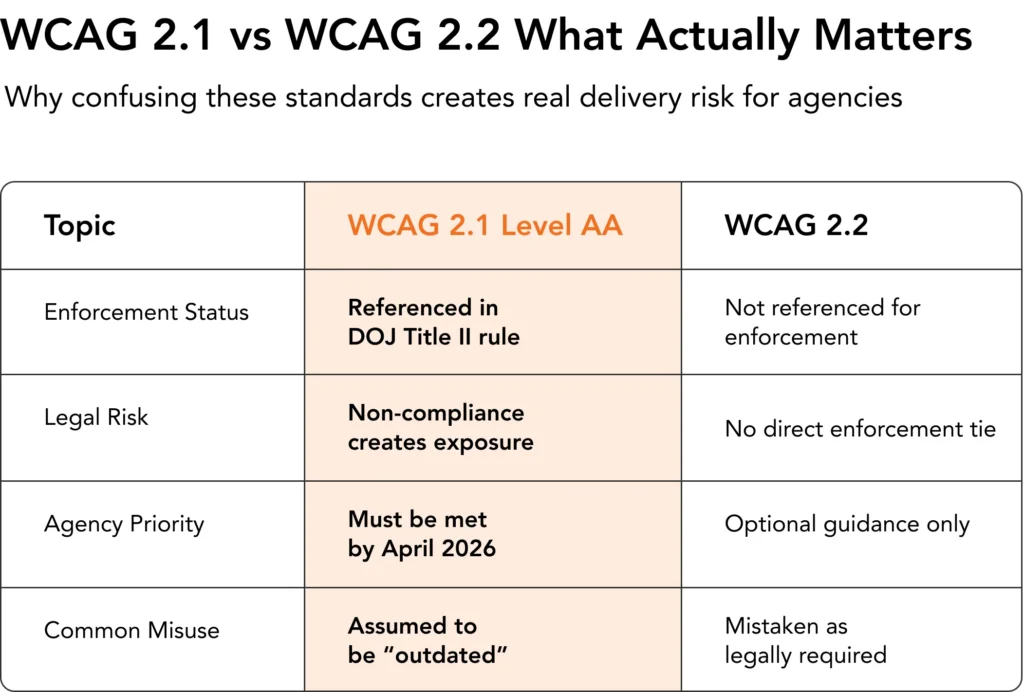
This misunderstanding leads agencies to misallocate effort—chasing newer criteria while leaving enforceable gaps unresolved. The W3C’s canonical WCAG 2.1 Recommendation defines the success criteria that agencies must meet, while What’s New in WCAG 2.2 explains additions without implying replacement.
The nuance matters. Accessibility work is already complex. When agencies aim at the wrong target, they burn time, confuse clients, and still leave sites exposed.
Clarity here is not academic—it’s protective..
Accessibility Debt Is Real Delivery Debt
Accessibility issues don’t sit in isolation. They compound inside the same systems that already carry technical and design debt.
Delaying WCAG 2.1 Level AA compliance doesn’t pause the work—it multiplies it.
When accessibility is deferred, it quietly embeds itself into templates, components, content workflows, and QA assumptions. By the time remediation is required, agencies aren’t fixing a checklist—they’re untangling years of layered decisions.
Common failure modes include:
- Global templates that were never built with semantic structure
- Design systems that ignore contrast and focus states
- Forms and PDFs produced outside any accessibility review
- CMS constraints that block compliant fixes without refactoring
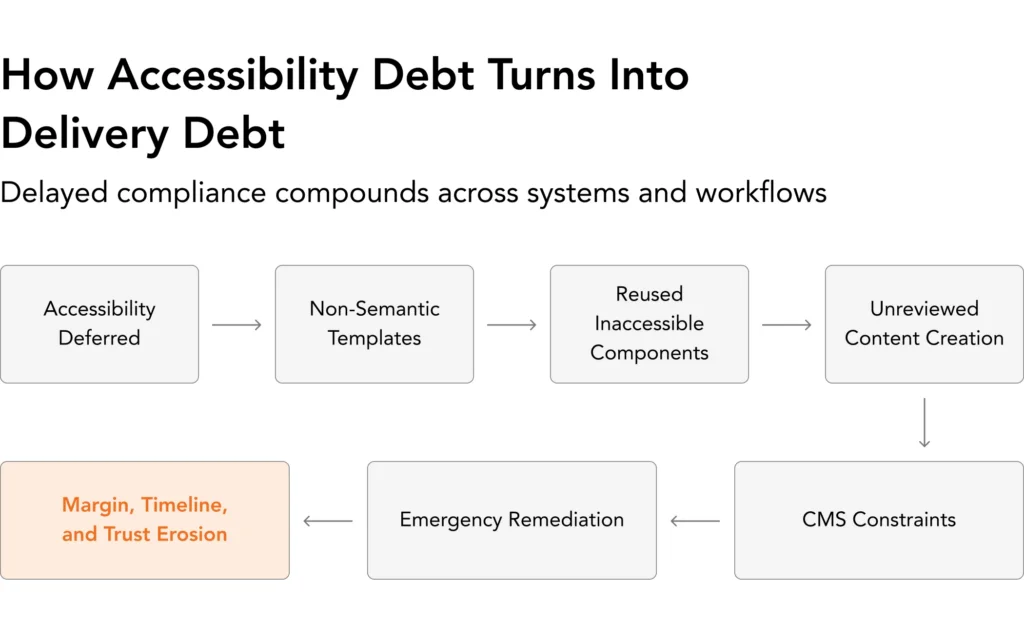
This is why accessibility remediation often feels disproportionate to the original request. The work isn’t hard because accessibility is complex. It’s hard because the delivery system was never designed to support it.
Most agencies already recognize this pattern in other areas of execution.
Accessibility debt follows the same curve. Early acknowledgment keeps it manageable. Late acknowledgment turns it into emergency work that absorbs margin, time, and trust.
Why Public Sector Risk Always Flows Downstream to the Agency
When accessibility enforcement begins, the legal obligation may sit with the public entity—but the operational fallout rarely stays there.
In practice, enforcement pressure flows downstream to the agency responsible for making the site work.
Here’s the pattern agencies see repeatedly. A public sector client receives pressure—sometimes from internal counsel, sometimes from advocacy groups, sometimes from formal complaints. That pressure turns into urgency. Urgency turns into requests. And those requests land with the agency as “Can we fix this quickly?”
At that point, the question is no longer about standards. It’s about delivery.
Agencies are asked to:
- Diagnose issues across years of inherited work
- Commit to timelines without clear scoping
- Remediate legacy templates that were never designed for accessibility
- Do all of this while the site remains live and politically visible
The Federal Register’s official Title II final rule record makes clear that enforcement is real and finalized. What it doesn’t address is how the execution burden actually plays out inside agency workflows.
That gap is where agencies get exposed. Without early alignment, accessibility remediation becomes a textbook case of scope drift early signals requirements, compressed timelines, and retroactive expectations that erode margin and trust at the same time.
By the time enforcement pressure hits, agencies that haven’t prepared are no longer advising. They’re reacting.
The Hidden Costs of Waiting Until Clients Panic
Waiting feels neutral—until it isn’t.
The real cost of delay shows up as operational chaos, not line items on a proposal.
When agencies wait for clients to panic, several things happen at once:
- Accessibility conversations become emotionally charged instead of planned
- Timelines compress before scope is understood
- Teams are pulled into remediation alongside active delivery
- Estimates become defensive instead of accurate
These moments rarely create clean projects. They create interruptions.
And interruptions are expensive. Not just in billable hours, but in lost predictability, stressed teams, and compromised quality. Agencies already know how damaging this pattern is in other contexts. It’s the same productivity drain described in delivery predictability systems.
Accessibility is no different. When it arrives late, it competes with everything else your agency is already delivering.
Waiting doesn’t reduce work. It concentrates it—at the worst possible time.
Legacy CMS Templates Are Where Accessibility Quietly Breaks
Most public sector sites aren’t rebuilt often. They evolve. Incrementally. Quietly.
That’s exactly why accessibility issues hide so well—and surface so painfully.
Legacy CMS environments introduce predictable risk:
- Templates built before accessibility was considered
- WYSIWYG content that bypasses structure entirely
- Third-party plugins that break keyboard navigation
- PDFs uploaded without remediation workflows
- Mobile views that were never tested with assistive technology
These aren’t edge cases. They’re the default state of many government-owned sites agencies inherit.
Accessibility problems often don’t fail in obvious ways. They fail quietly—inside templates, workflows, and old systems.
Legacy Accessibility Risk Pattern Checker
Check the statements below that match how your site actually works. There are no right or wrong answers.
The challenge isn’t identifying one issue—it’s recognizing that accessibility touches every layer of the system. Fixing one page doesn’t fix the template. Fixing the template doesn’t fix the content pipeline. And fixing either without understanding CMS constraints leads to partial compliance that fails under scrutiny.
Accessibility doesn’t fail loudly in legacy systems. It fails quietly, until it’s urgent.
What a Real Accessibility Audit Looks Like for Agencies
Most agencies think they’ve “looked at accessibility” because a tool was run or a report was generated. That creates confidence—but not coverage.
A real accessibility audit is not a scan. It’s a delivery-level discovery process.
For agencies managing public sector sites, an audit has to answer questions that tools cannot:
- Where do templates structurally block compliance?
- Which components are reused across hundreds of pages?
- How does content actually get created and updated?
- What breaks when accessibility fixes meet CMS constraints?
A practical audit typically moves through clear stages:
- Template and component review before page-level fixes
- Manual testing alongside automated signals
- CMS and workflow analysis—not just front-end output
- Prioritization based on systemic risk, not issue count
This is where agencies either regain control—or lose it. When discovery is rushed, remediation turns into reactive patching. When discovery is deliberate, agencies can sequence work, set expectations, and protect timelines.
This is also why accessibility work should start with credible discovery, not late-stage fixes. Website audit services designed to surface hidden delivery risks exist to give agencies a defensible starting point before urgency collapses decision-making.
Clarity at the audit stage is what keeps accessibility from becoming chaos later.
Proactive Accessibility Is a Client Trust Advantage
Accessibility conversations don’t just reduce risk—they change how clients see the agency.
Agencies that lead early on compliance are perceived as more credible, not more cautious.
This matters because trust isn’t built on perfection. It’s built on foresight and communication.
- “73% of agency leaders say agencies must prove their value to clients in an environment of greater competition, emerging technologies, economic uncertainty, and the pervasive deterioration of buyer trust.”
- “86% of agency leaders say they are making operational or process changes in response to market forces.”
Leading on accessibility is exactly that kind of operational signal. It shows clients you understand downstream risk before it becomes visible.
Client-side trust data reinforces the same pattern:
- “Respondents are most likely to say their best agency/agencies exceeds their expectations on communication (44%) and understanding their customers, industry, and business goals (40% each).”
- “Many (42%) say they absolutely trust their agency’s/agencies’ strategic recommendations; 51% say they do to some degree.”
Accessibility becomes an opportunity when agencies frame it early, clearly, and realistically—not as fear, but as preparedness.
Proactivity builds trust. Panic erodes it.
The Only Defensible Agency Posture Before April 2026
By now, the pattern should be clear. Waiting does not preserve optionality. It narrows it.
The only defensible posture for agencies before April 2026 is proactive ownership of accessibility risk—without overpromising remediation speed.
That posture includes:
- Acknowledging WCAG 2.1 Level AA as the enforceable standard
- Auditing legacy systems before clients demand fixes
- Separating discovery from remediation in scope and timelines
- Communicating clearly about what can and cannot be fixed quickly
The DOJ has been explicit about intent and seriousness. The Department of Justice’s announcement on publishing the final rule reinforces that this is about real access to public digital services—not symbolic compliance.
For agencies, that means the window for quiet preparation is now. Not because enforcement is tomorrow—but because the delivery consequences of waiting are entirely predictable.
Accessibility readiness is no longer a nice-to-have. It’s part of responsible agency delivery.
April 2026 Is a Deadline—but the Risk Starts Much Earlier
April 2026 is the date everyone will circle. But for agencies, the real risk window opens much sooner.
The moment a public sector client realizes accessibility is enforceable, the agency inherits the urgency—ready or not.
That urgency doesn’t arrive with clean scope, realistic timelines, or full context. It arrives layered onto live sites, legacy systems, and existing delivery commitments. Agencies that prepared early will have language, audits, and sequencing ready. Agencies that didn’t will be forced to react inside compressed timelines where margin and trust are hardest to protect.
This isn’t about becoming an accessibility specialist overnight. It’s about acknowledging where responsibility actually lands when enforcement pressure appears—and making sure your delivery system can absorb it.
Accessibility doesn’t become urgent in April 2026.
It becomes urgent the moment a client asks, “Are we exposed?”
Agencies that can answer that question calmly will be the ones clients trust when the pressure rises.
ADA Website Accessibility FAQs Agencies Are Actually Asking
FAQs
Does This Deadline Apply To All Government Websites Or Only New Builds?
The DOJ Title II rule applies to state and local government digital services broadly, including existing websites and mobile apps. This means agencies managing legacy sites are just as exposed as those launching new builds. Waiting for a rebuild does not remove risk—it concentrates it.
Is WCAG 2.2 Required For Compliance By April 2026?
No. WCAG 2.1 Level AA is the enforceable standard tied to DOJ enforcement. WCAG 2.2 may offer guidance, but it does not replace 2.1 for legal compliance. Confusing the two often leads to misplaced effort without reducing exposure.
Can Accessibility Issues Be Fixed With Automated Tools Alone?
Automated tools help identify surface-level issues, but they cannot evaluate templates, workflows, or CMS constraints. Relying on scans alone creates false confidence—and that’s where agencies get surprised later.
Is Accessibility Ultimately The Client’s Legal Responsibility, Not The Agency’s
Legally, the obligation sits with the public entity. Operationally, the execution burden flows to the agency. When urgency hits, agencies are expected to diagnose, scope, and fix—regardless of contract language.
What If A Client Can’t Fix Everything Before April 2026?
Partial remediation is common, especially on legacy systems. The risk isn’t imperfection—it’s lack of clarity. Agencies that document audits, priorities, and limitations are far more defensible than those reacting without structure.
When Should Agencies Start Talking To Clients About This?
Earlier than feels comfortable. Proactive conversations create planning space; late conversations create panic. Agencies that lead now control expectations instead of inheriting them.