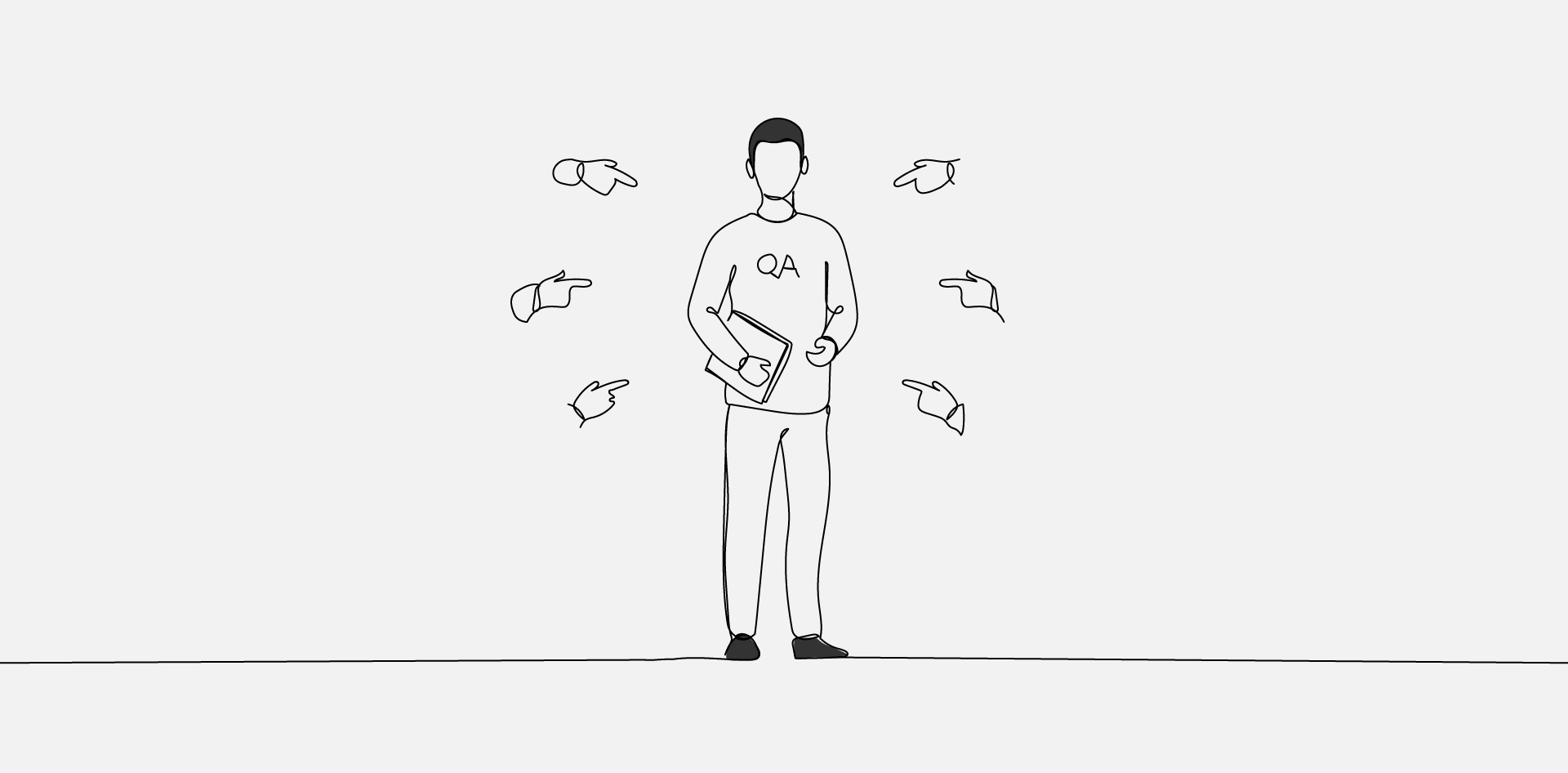
When QA Becomes the Place Accountability Goes to Hide
A client flags issues during review.
A few things aren’t behaving as expected. A detail is off. Something “doesn’t feel right.” The room goes quiet.
Leadership turns to QA.
Internally, everyone knows the truth: those “bugs” were never fully defined in the first place. The requirements sounded clear enough to move forward. The edge cases were acknowledged but deferred. The tradeoffs were understood—but never explicitly decided.
Now the work is visible.
And QA is holding the bag.
QA doesn’t create most delivery failures—it reveals decisions leadership avoided making earlier.
That’s why QA keeps taking the blame. Not because it failed—but because it’s where ambiguity finally collides with reality. By the time issues surface, the original cause has already been rewritten. What began as uncertainty now looks like sloppiness. What felt like a reasonable shortcut now feels like a quality failure.
This blog is about that quiet shift of accountability—and why agencies keep misdiagnosing it.
How Undefined Decisions Quietly Travel Downstream
Most delivery failures don’t start with bad execution.
They start with decisions that were never fully made.
Under timeline pressure, leadership teams often choose momentum over clarity. Not recklessly—but incrementally. A requirement sounds “good enough.” An edge case is noted but parked. A definition of “done” is implied instead of confirmed.
Each choice feels small. Reasonable. Temporary.
But every undefined decision doesn’t disappear—it moves downstream.
This is the core failure pattern agencies repeat.
- Leadership avoids forcing clarity
Decisions feel premature. Tradeoffs feel uncomfortable. Risk is left undefined. - Delivery absorbs the ambiguity
Teams fill gaps with assumptions to keep work moving. Progress continues—but certainty doesn’t. - QA inherits compounded uncertainty
Testing is no longer about verification. It’s about resolving questions that should have been answered earlier. - Clients experience defects, not context
What they see are errors—not the leadership pressure that caused them.
QA sits at the end of this chain, which makes it the most visible point of failure. But visibility isn’t causation.
QA doesn’t introduce risk. It exposes the cost of letting decisions drift.
This is why moving quality “upstream” matters—but not as a testing tactic. As IBM explains in its overview of shift-left testing, catching issues earlier reduces rework and late-stage surprises. For agencies, the deeper lesson is simpler:
That’s how QA becomes the scapegoat. Not because it failed—but because leadership let uncertainty travel unchecked.
Decision Debt Compounds Faster Than Teams Expect
Decision debt forms when teams move forward without resolving questions that feel minor in the moment. The assumption is that clarity can be added later, once there’s more context or more certainty.
That assumption is expensive.
The Decision Debt Curve shows why. Early in a project, decisions are cheap. Clarifying scope, defining acceptance criteria, or forcing tradeoffs costs time—but very little goodwill. Later, those same decisions trigger rework, timeline disruption, and client frustration.
The Economics of Product Decisions
In the early stages of a product lifecycle, every choice feels like a whiteboard exercise. But as code is written, architectural patterns are established, and client expectations are set, the flexibility of your system begins to harden.
Decision Debt Compounds Faster Than Teams Expect
The Decision Debt Curve shows why. Early in a project, decisions are cheap… Later, those same decisions trigger rework, timeline disruption, and client frustration.
Early Phase: High Agility
Decisions are low-risk. Changes mean updated documentation, team clarification, and early alignment. Fixes are measured in minutes or hours.
Use the slider above to explore how project costs escalate as decisions are deferred.
The goal of any high-performance team is to shift critical decisions to the “Early” zone. By front-loading alignment, you avoid the exponential trap of mid-project pivots and late-stage rework that drains both budget and team morale.
Decision debt doesn’t grow linearly. It compounds.
By the time QA encounters unresolved questions, the cost is no longer technical. It’s relational. Fixes now affect delivery confidence, not just delivery output.
This escalation pattern has been documented for decades. Post-delivery fixes can cost dramatically more than early-phase fixes, according to research summarized by NASA’s Technical Reports Server.
Why Late Fixes Feel Like Sloppiness to Clients
Inside an agency, late fixes are framed as responsible problem-solving. Teams caught an issue. QA did its job. The system worked.
Clients experience the same moment very differently.
They don’t see internal checkpoints or timeline pressure. They see something that was supposed to be finished—not finished. Repeated issues, even small ones, begin to feel like a lack of care or discipline rather than normal iteration.
This is why quality failures are so often interpreted as communication failures. The pattern shows up repeatedly in client feedback, and it’s one reason Agencies Often Fail At Communication — Are You Guilty resonates so strongly with agency leaders.
Modern research reinforces this perception gap. Repeated software issues are experienced as repeated trust hits—not isolated defects, as summarized in the Harness 2024 Software Failure Sentiment Report.
The Trust Erosion Ladder Inside Agency Relationships
Trust rarely collapses all at once. It erodes in stages.
The Trust Erosion Ladder explains how repeated delivery issues—often rooted in upstream ambiguity—quietly shift how clients relate to an agency.
Stage 1: Confidence
Clients assume competence. Small issues are forgiven.
Stage 2: Vigilance
Clients start double-checking work. Questions increase. Reviews get tighter.
Stage 3: Interpretation Shift
Mistakes stop being seen as tradeoffs and start being seen as patterns.
Stage 4: Disengagement
Clients emotionally detach before contracts end.
Where Is Your Client Right Now?
Pick the client behavior you’re seeing most often. The stage and next step will update.
This progression aligns with what agency leaders already feel in their accounts. According to Agency Edge Research 2023 (AMI / Audience Audit), 51% of respondents who ended an agency relationship said “the quality of the work was not up to our standards.”. The same research shows that 42% of respondents say they absolutely trust their agency’s strategic recommendations, while 51% say they trust them only to some degree, indicating fragile trust that can erode quickly.
Clients also define “quality” systemically. Clients say their best agency exceeds expectations on communication (44%) and meeting deadlines (34%). When those expectations slip, trust follows.
QA Becomes the Scapegoat When Governance Is Missing
When delivery breaks down, QA is the easiest place to point. It’s visible. It’s measurable. And it sits closest to the moment failure becomes undeniable.
That convenience is precisely the problem.
| Myth | Reality |
|---|---|
| QA failed to catch the issue | The issue was never fully defined |
| Testing was insufficient | Decisions were deferred upstream |
| QA slowed the project down | Ambiguity forced revalidation |
| Bugs caused client frustration | Unclear commitments caused distrust |
QA becomes the scapegoat because it’s the last line of defense—not because it’s the source of the failure.
Blame travels downstream when accountability doesn’t move upstream.
Without governance—clear checkpoints where decisions are forced and confirmed—QA is left validating guesses instead of verifying intent. At that point, no amount of testing discipline can protect trust.
What Early Checkpoints Actually Protect
Early checkpoints aren’t about slowing delivery. They’re about preventing invisible risk from compounding.
The most effective checkpoints do one job well: they force decisions while they’re still cheap.
- Scope confirmation before execution begins
Clarifies what is included, what is excluded, and what requires change control. - Acceptance criteria alignment
Ensures everyone shares the same definition of “done.” - Tradeoff visibility
Makes time, cost, and quality constraints explicit instead of implied. - Decision ownership
Assigns responsibility for unresolved questions instead of letting them drift.
The logic behind this is well established. The Project Management Institute’s explanation of the cost of change curve shows that the later a change occurs, the more disruptive and expensive it becomes.
What matters operationally is where these checkpoints live. Agencies that build them into delivery—not just QA—protect timelines, margins, and trust.
Quality Is a Leadership System, Not a Testing Function
Quality isn’t something that happens at the end of a project.
It’s something that’s designed into the system from the beginning.
Leadership sets the conditions for quality long before QA engages—through how decisions are made, how clarity is enforced, and how risk is surfaced instead of deferred.
When leaders treat QA as a safety net, they unknowingly weaken it. When they treat quality as a governance responsibility, QA becomes what it’s meant to be: confirmation, not cleanup.
This shift—from testing mindset to leadership system—is what separates agencies that constantly apologize from agencies that quietly retain trust.
Closing the Gap Before QA Ever Sees the Work
QA often takes the blame because it’s where uncertainty finally becomes visible.
But the real work of quality happens much earlier—when leaders choose whether to force clarity or defer it. When they decide whether to slow down just enough to make decisions cheap. When they determine whether ambiguity is named or quietly passed along.
Once risk reaches QA, the damage is already in motion. Fixes may still be possible. Trust recovery is harder.
Agencies that break this pattern don’t test harder.
They decide earlier.
They surface tradeoffs while they’re still negotiable.
They treat quality as a governance discipline—not a downstream function.
That’s how QA stops being a scapegoat.
And starts being what it was always meant to be: confirmation that the right decisions were already made.
Questions Agency Leaders Actually Ask About QA and Trust
FAQs
If QA isn’t the problem, why do issues keep showing up there?
Because QA is where unresolved decisions finally collide with reality. It’s the first place ambiguity is forced into a yes-or-no answer.
Isn’t some level of rework just normal in agency delivery?
Some iteration is normal. Repeated late-stage fixes caused by unclear expectations are not. That’s decision debt, not healthy iteration.
How do we know whether an issue was a QA miss or an upstream failure?
Ask whether the expectation was explicit before work began. If it wasn’t clearly defined, QA didn’t miss it—leadership deferred it.
Why do clients react so strongly to small defects?
Because clients don’t experience defects as isolated events. They experience them as signals about care, discipline, and reliability.
Does pushing for more clarity early slow teams down?
Briefly. And then it speeds everything else up. Early friction prevents late disruption.
What’s the fastest way to reduce QA pressure without cutting corners?
Force decisions earlier. Especially around scope boundaries, acceptance criteria, and tradeoffs. QA pressure drops when ambiguity does.