How We Build a Custom Chatbot
From Brief to Launch
Four phases. Six to eight weeks. Every chatbot follows the same disciplined process so nothing gets missed and your client sees progress at every stage.


We are born from an agency and made for an agency.
Meet your team of talented and dedicated professionals.
Key partners for opportunities.
We configure, train, and launch chatbots on proven platforms. Knowledge base bots that answer real questions.
Lead qualification bots that filter before sales sees it. Support triage bots that cut ticket volume. 2–3 weeks from contract to live.
Your brand. Your client. We deliver.
Custom chatbot integration is the process of building, training, and deploying a purpose-built conversational AI on a client’s website or application. Unlike off-the-shelf chat widgets, a custom chatbot is trained on the client’s actual content — help docs, FAQs, product pages — and answers questions using real information instead of scripted responses.
The difference between a chat widget and a custom chatbot comes down to what happens when a customer asks something unexpected.
Client has 50+ support articles nobody reads. Bot searches them all in real time and answers from actual content instead of guessing.
Real example: Accounting firm with a 200-page help center. Bot trained on all content. Support emails dropped 40% in 60 days. Senior staff reclaimed 5+ hours per week.
Setup: $5K–8K | Recurring: $100–150/month
Website gets traffic but the contact form converts at 2%. Bot asks qualifying questions in real time, routes hot leads to sales, sends resources to everyone else.
Real example: B2B SaaS marketing site. Bot replaced static form. Qualified leads increased 35%. Sales team stopped wasting time on unqualified inquiries.
Setup: $8K–12K | Recurring: $150–200/month
Support team answers the same 10 questions daily. Bot handles the repetitive ones. Complex issues escalate to humans with full conversation context attached.
Real example: E-commerce brand with 200+ daily support tickets. Bot resolved 45% without human intervention. Average response time dropped from 4 hours to 12 seconds.
Setup: $6K–10K | Recurring: $120–200/month
Customer asks “do you have this in red?” or “what pairs well with this?” Bot searches the catalog, suggests alternatives, and guides toward checkout.
Real example: Online retailer with 3,000+ SKUs. Bot handles product questions, suggests alternatives when items are out of stock. Add-to-cart rate increased 15%. Average order value up 12%.
Setup: $7K–11K | Recurring: $150–250/month
New customers sign up and immediately feel lost. Bot provides guided setup, answers “how do I…” questions, and reduces time-to-first-value by 30–40%.
Real example: SaaS platform with a 30-day free trial. New users reached first value 40% faster. Trial-to-paid conversion improved from 22% to 26%. Demo call volume decreased 35%.
Setup: $6K–9K | Recurring: $100–150/month
We build on two platforms depending on what the client needs. One excels at knowledge retrieval. The other excels at conversation design. Choosing wrong means rebuilding later.
Core method: RAG (Retrieval-Augmented Generation)
Ingests documents, help articles, and website pages. Answers questions by retrieving relevant content and generating responses grounded in real data.
Best for: Knowledge base bots, FAQ automation, internal documentation search
Core method: Visual conversation builder + AI nodes
Drag-and-drop flow editor with conditional logic, API integrations, and AI-powered decision nodes. Handles multi-step conversations with branching paths.
Best for: Lead qualification, onboarding flows, e-commerce assistants, support triage
| DocsBot AI | Botpress | |
|---|---|---|
| Setup time | 1–2 weeks | 2–4 weeks |
| Conversation depth | Single-turn Q&A | Multi-step flows |
| Hallucination risk | Low (grounded in docs) | Very low (scripted paths) |
| CRM integration | Limited | Native (HubSpot, Salesforce) |
| Monthly cost | $50–150 | $100–250 |
Clients often confuse these three. Each solves a different problem at a different price point. Selling the wrong one creates churn. Here is how they differ.
Human-powered, real-time
Cost to client:
$200–500/month + staff timeAI-powered, 24/7 availability
Cost to client:
$5K–12K setup + $100–250/monthAI-powered, takes actions autonomously
Cost to client:
$15K–40K setup + $300–800/monthFour phases. Six to eight weeks. Every chatbot follows the same disciplined process so nothing gets missed and your client sees progress at every stage.
These are composite examples drawn from actual client engagements. The problems are real. The results are representative of what a properly built chatbot delivers within 90 days.
Problem: Patient portal had 300+ FAQ pages. Call center handled 400+ calls per day — 60% were questions already answered on the website.
Solution: Trained bot on the entire FAQ library plus provider directories. Added appointment-related escalation paths to live agents.
Result: Call volume dropped 35% in 8 weeks. Patient satisfaction scores for digital experience increased from 3.2 to 4.1 out of 5. Estimated annual savings: $180K in call center costs.
Problem: Website generated 200+ form submissions per month. Sales team spent 15 hours per week qualifying leads manually. 70% were unqualified.
Solution: Multi-step qualification bot that asks about company size, budget range, timeline, and use case before routing to sales or sending resources.
Result: Qualified lead volume increased 40%. Sales team reclaimed 12 hours per week. Average deal cycle shortened by 8 days because reps started conversations with context.
Problem: 45% of new users never completed setup. Onboarding emails had 18% open rate. Support tickets from confused new users consumed 30% of the support team’s time.
Solution: In-app onboarding bot that guides new users through account setup, first-course selection, and initial feature orientation step by step.
Result: Onboarding completion jumped from 55% to 78%. Trial-to-paid conversion improved by 4 percentage points. Support tickets from new users dropped 50%.
These are real market rates for custom chatbot projects in 2025. The margins are strong because most agencies are not offering this service yet. Early movers set the price.
Two paths. Same outcome: your client sees your brand on every deliverable. We never appear in any client-facing communication, documentation, or interface.
You handle the client relationship and sales process. We handle the entire technical build from discovery to deployment. Your client never knows we exist.
Your team handles some components — maybe the design or the content strategy. We handle the technical implementation and platform configuration.
Deploying the chatbot is not the finish line. The first 90 days of real conversations are where the bot actually gets good. Here is what we do after go-live.
Most custom chatbot projects take 6 to 8 weeks from kickoff to production deployment. Simple knowledge base bots can launch in 3 to 4 weeks. Complex multi-step bots with CRM integrations typically require the full 8 weeks. The timeline includes discovery, build, testing, and a supervised launch period where we monitor the first 500 conversations.
A chatbot answers questions and guides conversations based on trained content. An AI agent takes autonomous actions — connecting to APIs, executing workflows, and making decisions across multiple systems. Chatbots are conversational interfaces. AI agents are operational tools. Most businesses need a chatbot first. Agents come later when the use case requires system integration and autonomous decision-making.
Hallucination risk depends on the platform and training approach. DocsBot uses retrieval-augmented generation (RAG), which grounds every answer in actual source documents — reducing hallucination to near zero. Botpress uses scripted conversation flows where responses follow defined paths. Both approaches are significantly safer than connecting a raw language model to a website. We also configure fallback responses so the bot says “I do not know” instead of guessing.
Setup costs range from $5,000 to $18,000 depending on complexity. A basic knowledge base bot starts around $5,000. A lead qualification bot with CRM integration runs $8,000 to $12,000. A full chatbot suite with multiple bots and analytics starts at $12,000. Monthly maintenance and platform fees run $100 to $250 on our end. Agencies typically mark up the full package by 50 to 65 percent.
Yes. Botpress has native integrations with HubSpot, Salesforce, Zendesk, and Intercom. DocsBot integrates with Slack, Zapier, and custom webhooks. For platforms without native connectors, we build custom API integrations. CRM integration is critical for lead qualification bots so that qualified leads flow directly into the sales pipeline with full conversation context.
The bot needs the same content your client’s customers already look for — FAQ pages, help articles, product documentation, pricing pages, and policy documents. We audit the client’s existing content library during the discovery phase and identify gaps. If content is missing, we flag it before build begins. The quality of the training data directly determines the quality of the bot’s responses.
Completely. Your client never sees our name on any deliverable, interface, or communication. The chatbot UI matches the client’s brand. All documentation carries your agency’s branding. We join standups and Slack channels as your team members when needed. The entire engagement is positioned as your agency’s capability.
Every bot we build includes escalation paths. When it cannot answer confidently, it transfers the conversation to a human agent with the full chat transcript attached. No dead ends. No loops. The customer gets help, and the support agent starts with context instead of asking the customer to repeat everything. We configure escalation triggers during the build phase based on the client’s support workflow.
Yes. Both DocsBot and Botpress support multi-site deployment. A single bot can serve a website, a mobile app, a Slack workspace, and a help center simultaneously. Each deployment point can have its own UI styling while sharing the same knowledge base and conversation logic. Multi-channel deployment is included in the setup — no additional build cost for extra embed points.
We track five core metrics from day one: total conversations, resolution rate (questions answered without human help), escalation rate, customer satisfaction score (collected via post-chat survey), and top unanswered questions. Monthly reports are delivered in a format you can forward directly to your client. Most bots reach 85 to 90 percent resolution rate within 60 days of launch.
The one where someone’s calendar fills up because they’re processing leads manually. Where documents stack up waiting for data entry. Where reports get built on Thursday night for Friday morning and they’re always slightly wrong. The ops manager sighs a lot. It’s fixable.
Tell us about that client. Walk us through what happens now. The process. The tools. The steps that make people sigh. Don’t polish it. Messy is better than polished. Tell us how long it takes and what breaks regularly.
We’ll scope it. Build it. If it makes sense for your business we’ll move forward. If it doesn’t, we’ll tell you that too. That’s how partnerships actually last.
Your client thinks they hired you. You own the credit. You own the revenue. You own the relationship. We disappear into the delivery.
"*" indicates required fields
Turn complexity into clarity.
This digital guide makes it easy to say “yes” to more client work—with confidence, structure, and White Label IQ behind you.
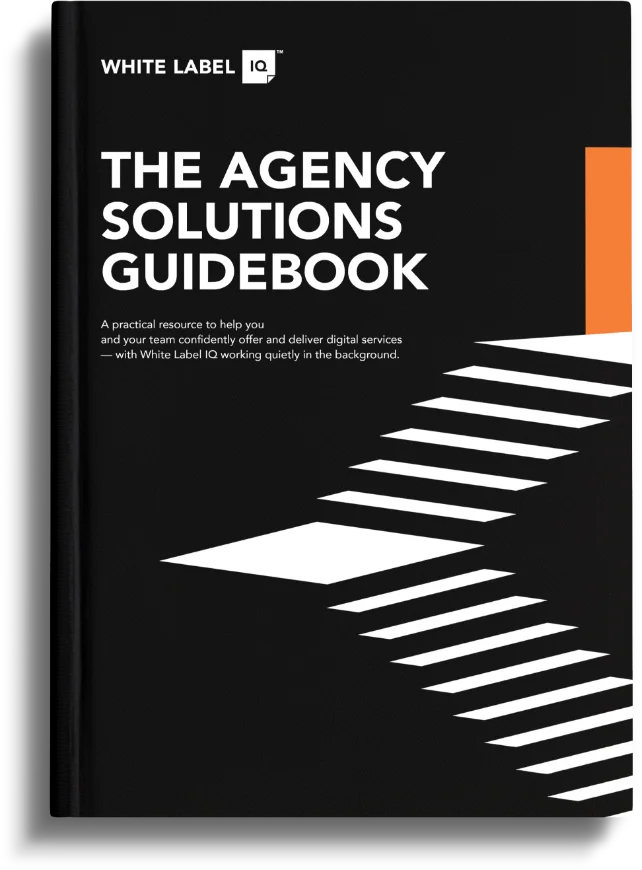
Fill out the form to get your digital guide with breakdowns of services, inclusions, and growth opportunities.