Imagine hiring a chef. She’s talented—trained, experienced, recommended by three people you trust the most. She prepares a dish. You taste it, and pause. Something’s not right.
And you say: “It needs to be more… dinner-y.”
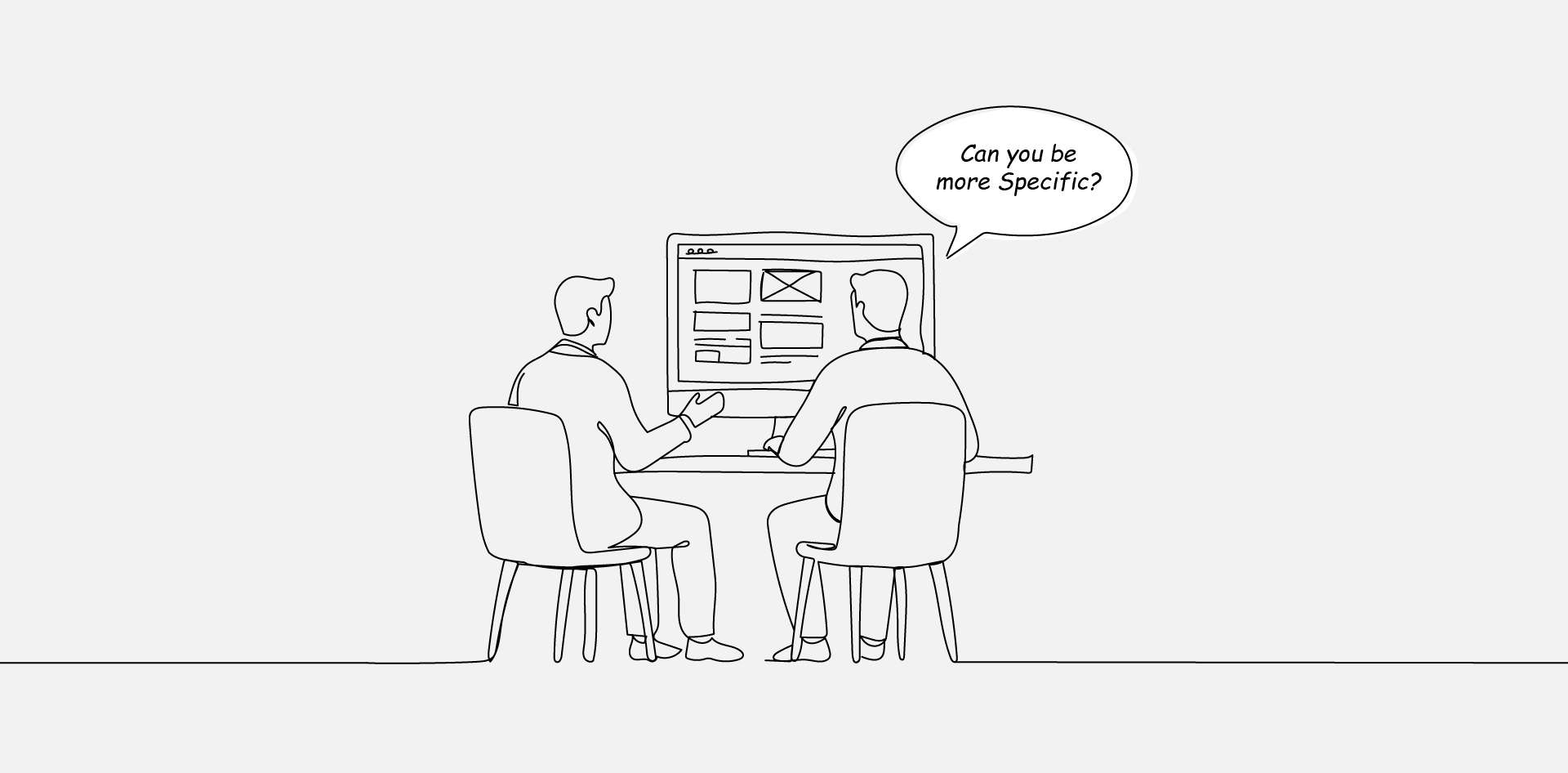
She stares at you. “Can you be more specific?”
“Yeah, it’s just not giving dinner. It’s more lunch energy. Can you make it feel like an evening? But keep the chicken.”
That’s what designers hear forty times a week. Not because clients are ridiculous—but because evaluating creative work is a skill, and nobody ever handed the client a vocabulary menu.
They can tell something’s off the same way you can tell a dish isn’t right. The problem is describing what and why—and that requires a framework most people were never given.
Chefs solve this by asking questions. Is it the seasoning? The texture? The temperature? They don’t expect the diner to speak like a culinary school graduate—but they do guide the conversation toward something usable.
Agencies almost never do this. They hand the client the design, wait for a reaction, and then try to reverse-engineer meaning from “it needs to feel more elevated.” After a point, that’s a guessing game with a budget attached to it.
The Anatomy of Feedback That Produces Rework
Not all feedback is created equal. There’s a meaningful difference between a response that moves a project forward and one that sends it sideways, and the distinction comes down to whether the feedback contains enough information for the team to act on it without guessing.
Preference statements are the most common form of feedback agencies receive, and they’re the least useful. “I don’t love the colour palette” tells the designer what the client feels, but says nothing about what the work needs.
“The colour palette feels too casual for our audience, which is mostly procurement directors at enterprise companies,” is a different kind of statement entirely. It connects the reaction to a reason, and the reason points toward a solution.
It’s the difference between a diner saying “this doesn’t taste right” and saying “this is too sweet for what I expected from a savoury dish.” The chef can’t do anything with the first one. The second one tells them exactly where to adjust.
According to a PMI Pulse of the Profession report, poor communication is a contributing factor in 56% of failed projects. The finding applies to IT and construction, but the principle holds in creative work too—when the communication around feedback is vague or misaligned, the project suffers regardless of how talented the team executing it is.
Most clients default to preference statements not because they’re lazy, but because they’ve never been shown another way to respond. They’re tasting the dish and reacting—too salty, too bland, not what I expected—without being able to point to the ingredient that’s causing it.
The revision loop that follows is a communication failure the agency could have prevented before the first plate ever left the kitchen.
The Three-Question Feedback Template
One of the simplest interventions an agency can introduce is a structured feedback template that replaces freeform reactions with guided responses.
Three questions are usually enough to transform the quality of a feedback round.
What Is Working and Why?
This question forces the client to identify the elements they want to keep before they start listing what they want to change. It also gives the designer a map of what’s landing correctly, which is information that freeform feedback seldom includes.
“The hierarchy feels right, and the headline draws me in immediately” is significantly more useful than “I like it” because it protects the parts of the design that are already doing their job.
What Isn’t Working and What’s Driving That Reaction?
The second half of this question is where the value lives.
“The hero image isn’t working” is a dead end. “The hero image isn’t working because it doesn’t reflect the premium positioning we discussed in the brief,” gives the designer a clear rationale and a direction to move toward.
When clients are asked to explain the reasoning behind their reaction, opinion becomes something a team can actually execute against.
Does This Align With the Goals We Defined at the Start?
This question anchors the entire review back to the project’s original objectives. It prevents the feedback conversation from drifting into subjective territory by reminding everyone that the work exists to accomplish something specific.
If the answer is yes, the conversation stays focused on refinement. If the answer is no, the conversation shifts to alignment—which is where it needed to be all along.
How to Run a Feedback Briefing Before a Design Review
A feedback briefing is a short session—fifteen to twenty minutes—held before the client sees any creative work. Its purpose is to set expectations around how to evaluate what they’re about to review and what kind of input will be most useful.
This isn’t a presentation about the work itself. It’s a conversation about how to respond to the work. The agency walks the client through the objectives the design is solving for, reminds them of the brief, and explains what stage the work is in.
This last part matters more than most agencies realize—feedback on a wireframe should look very different from feedback on a polished comp, and clients often don’t know that unless someone tells them.
The briefing also introduces the feedback template and explains how to use it. When clients know in advance that they’ll be asked “what’s working and why,” they approach the review with a different mindset. They look for specifics instead of scanning for gut reactions.
They evaluate against the brief instead of against personal taste. And the feedback that comes back is something the team can act on in a single round instead of three.
A Geneca survey on project alignment found that only 23% of project managers and stakeholders agreed on when a project was actually complete—a misalignment that often traces back to how objectives and feedback were communicated from the start.
A fifteen-minute briefing before the first design review costs nothing and can prevent weeks of misdirected revision work.
Reference-Based Direction vs. Preference Statements
One of the most effective ways to improve feedback quality is to shift clients from stating preferences to providing references. “I want it to feel more modern” is a preference statement that means something different to every person in the room.
“Here’s a site that has the kind of modern feel I’m thinking of” is a reference, and it gives the designer something concrete to interpret.
Agencies can encourage this shift by asking for references early—during the discovery phase, before any design work begins. When clients share examples of work they respond to, the team can identify patterns in what the client values and build those into the creative direction from the start. This front-loads alignment instead of discovering mismatches three rounds into the project.
References also reduce the ambiguity of revision requests. “Make the typography bolder” could mean a dozen things. “Make the typography feel more like this example we discussed during kickoff” narrows the interpretation to something manageable. The reference becomes a shared vocabulary that both sides can point to when words aren’t precise enough.
The key is making reference collection a standard part of the discovery process rather than something that only happens when a project is already off track. By the time an agency is asking, “Can you show me what you mean?” in round two, the damage is already done.
Managing Conflicting Feedback From Multiple Stakeholders
Single-stakeholder feedback is difficult enough. Multi-stakeholder feedback is where most revision loops become unrecoverable. The VP of marketing wants one direction, the founder wants another, and the product lead has a third opinion that contradicts both.
The agency tries to reconcile all three perspectives and ends up with a design that satisfies nobody because it was built by committee. The fix isn’t a better design; it’s a better feedback process.
Before any multi-stakeholder review, the agency should establish who the final decision-maker is and make that role explicit in writing. Feedback from other stakeholders is input, not instruction—and that distinction needs to be clear before the review begins, not after three rounds of conflicting revisions have already burned through the timeline.
Consolidation matters equally. Multiple stakeholders should never submit feedback separately to the agency. One person on the client side should own the task of collecting all input, resolving internal disagreements, and delivering a single set of consolidated notes.
If the client team can’t agree internally, that’s a conversation they need to resolve before the agency receives anything. Passing unresolved internal conflict to the design team doesn’t save time; it multiplies it.
This isn’t about being rigid or difficult with the client. It’s about protecting the work from a process failure that neither side benefits from.
When agencies set these expectations early—ideally in the kickoff—clients almost always appreciate the structure. They’ve been through messy feedback processes before, too, and most of them are relieved when someone finally puts a framework around it.
Better Feedback Is a Shared Investment
Feedback quality isn’t something agencies can afford to leave to chance. Every round of vague, conflicting, or preference-driven input costs hours that could have been spent refining the work instead of reinterpreting the request.
The agencies that invest in client feedback education don’t just reduce revision rounds; they get better output because the input was better from the start.
None of this requires a massive process change. A three-question template, a fifteen-minute briefing, an explicit decision-maker, and a reference library collected during discovery are enough to transform a feedback loop from a source of frustration into a genuine collaboration.
The tools are simple. The hard part is committing to them consistently rather than hoping the next client will instinctively know how to give useful feedback.
The next time a revision round produces rework instead of progress, it’s worth asking whether the problem was the design—or whether the client was ever given the tools to evaluate it well.
Frequently Asked Questions
FAQs
How Many Revision Rounds Should an Agency Include in a Project Scope?
Two to three rounds are standard for most design deliverables. The key is defining upfront what constitutes a revision versus a scope change—a revision refines execution within the agreed direction, while a scope change alters the direction itself.
When clients understand that distinction, they tend to be more deliberate about what they ask for in each round.
What If the Client Insists on Giving Freeform Feedback Instead of Using a Template?
Start by framing the template as something that helps the agency serve them better, not as a restriction. Most clients who resist structured feedback do so because they’ve never been asked to give it before.
If the agency positions the template as a tool that gets them better results faster, adoption usually follows.
For clients who still prefer freeform input, the account manager can use the template internally to translate the feedback into actionable notes before passing it to the design team.
Should Junior Team Members on the Client Side Be Included in Design Reviews?
Only if they have decision-making authority or domain expertise relevant to the deliverable. Adding reviewers who don’t have either creates noise without adding signal.
If junior stakeholders need visibility into the work, a separate informational walkthrough after the decision-makers have signed off is a better approach than including them in the feedback round itself.
How Do You Handle a Client Who Changes Direction After Approving a Previous Round?
This is where documented approvals become essential. If the client formally signed off on a direction and is now reversing course, the agency should flag it as a scope change rather than absorbing it as a standard revision.
Feedback briefings help prevent this scenario by anchoring each review to the project’s objectives, making it harder for the conversation to drift without anyone noticing.
Can White-Label Partners Help Agencies Manage the Feedback Process?
Experienced white-label partners often bring structured feedback workflows that agencies can adopt or adapt.
Because they work across dozens of agency relationships, they’ve seen what works and what doesn’t at scale—and they can help agencies build feedback processes that reduce revision cycles without adding overhead to the client relationship.