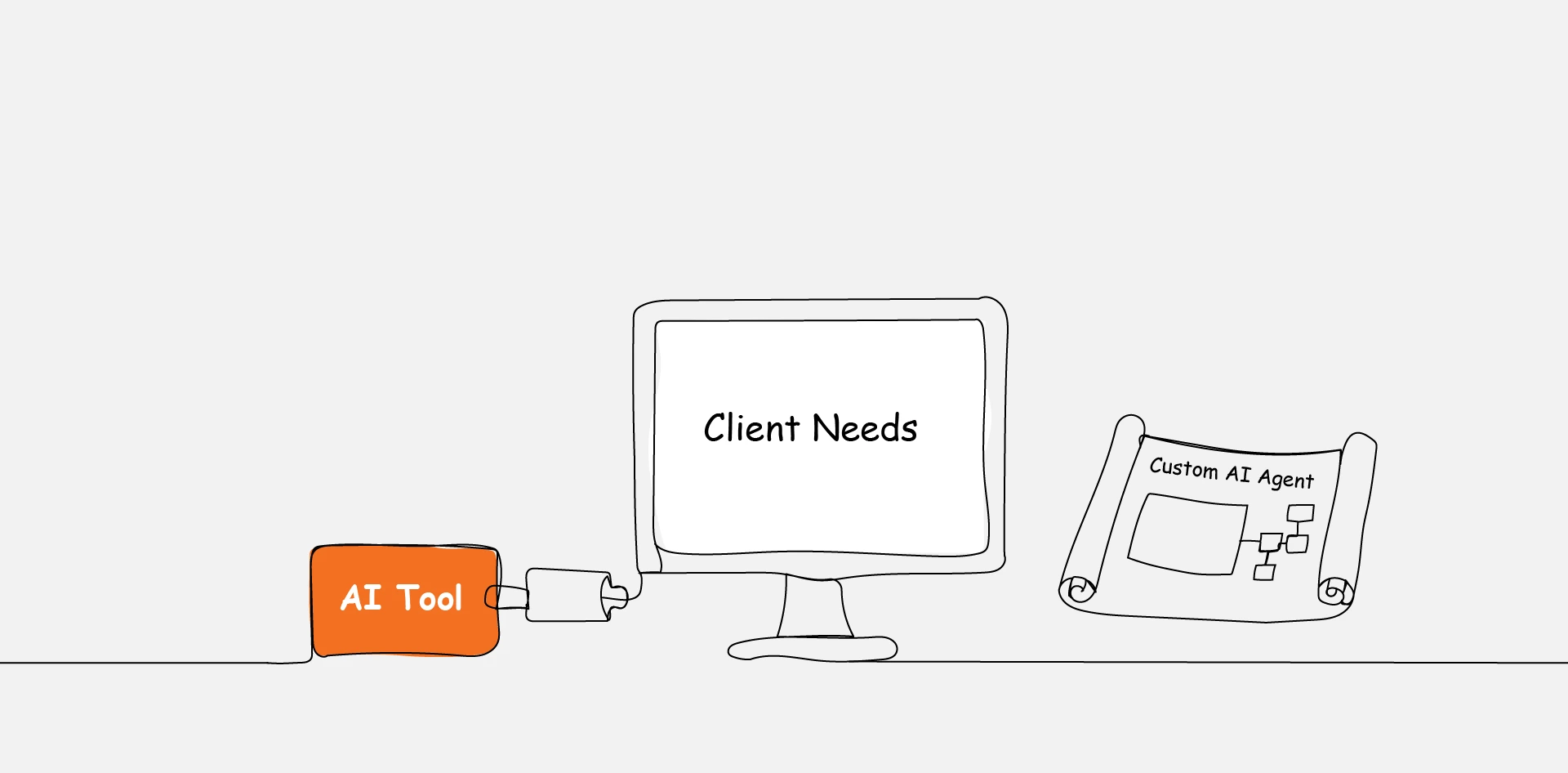
“We need a custom AI agent.”
That sentence kicked off a discovery call last month that ended with a $14,000 platform configuration instead of a $180,000 custom build. The client wasn’t wrong to ask—they just didn’t know what they were actually asking for.
The gap between what clients imagine when they say “custom AI agent” and what they actually need is wider than most agencies want to admit. Closing that gap honestly is one of the highest-value conversations an agency can have right now—and one of the riskiest to get wrong.
This article lays out a practical decision framework for evaluating when a custom build is genuinely warranted, when an off-the-shelf tool does the job, and how to navigate the recommendation without losing the client’s trust or the project.
What Custom Agent Development Actually Involves
Most clients picture custom AI agent development as a few weeks of clever prompt engineering stitched together with an API. The reality is closer to building a small software product from scratch—with all the complexity that implies.
A true custom AI agent requires a defined reasoning architecture, access to structured and unstructured data sources, integration with the client’s existing tech stack, and a testing framework that accounts for non-deterministic outputs.
That last piece alone separates AI development from traditional software. You’re not debugging logic errors—you’re evaluating whether a model’s probabilistic responses meet a threshold of accuracy across hundreds of edge cases.
Then there’s the infrastructure. Custom agents need hosting, monitoring, versioning, and rollback capabilities.
They need guardrails to prevent hallucination in production. They need logging systems that capture not just errors but drift—the slow degradation in output quality that happens as real-world inputs shift away from what the model was initially tuned for.
According to RAND Corporation research, over 80% of AI projects fail—roughly twice the failure rate of non-AI technology projects. The failure rate isn’t driven by bad ideas—it’s driven by underestimating the engineering surface area that sits between a working prototype and a production-grade system.
When Existing Tools Cover 90% of the Use Case
The AI tools market in 2026 looks nothing like it did even 18 months ago. Platforms like Jasper, Writer, Clay, Relevance AI, and dozens of vertical-specific tools have matured rapidly.
Many now offer configurable workflows, API access, native integrations, and role-based permissioning that would’ve required custom development a year ago.
When a client says they want an AI agent to summarize support tickets, draft follow-up emails, and flag escalation-worthy conversations—that’s three features, not three reasons to build.
A well-configured combination of existing tools, connected through native integrations or a lightweight automation layer like Zapier or Make, can deliver that outcome in days, not months.
Gartner predicts that CIOs are increasingly opting for commercial off-the-shelf AI solutions rather than internal builds, seeking more predictable implementation and clearer business value.
That trend isn’t driven by lack of ambition—it’s driven by painful experience with custom projects that overran timelines and underdelivered on outcomes.
The honest question to ask during scoping is this: Does the client need something that doesn’t exist, or do they need help finding and configuring what already does?
The Decision Matrix: Build, Buy, or Configure
Not every recommendation is binary. The real decision usually falls into one of three categories, and each carries a different cost structure, timeline, and risk profile.
- Configure an Existing Tool
This is the right call when the client’s use case maps cleanly to an existing platform’s feature set. The work involves selecting the right tool, connecting it to the client’s data sources, building workflows, and training the team. Cost is typically low five figures, and the timeline is measured in weeks.
- Extend a Platform With Custom Logic
Sometimes an existing tool gets 80% of the way there, but the last 20% requires custom API integrations, a proprietary scoring model, or a workflow that the platform doesn’t natively support.
This middle path combines a platform’s stability with targeted custom development. Cost ranges from the mid-five to low-six figures, depending on complexity. Timeline is one to three months.
- Build a Custom Agent From Scratch
This is warranted when the client’s requirements involve proprietary data pipelines, domain-specific reasoning that general-purpose models can’t handle, regulatory constraints that prohibit third-party data processing, or workflows so unique that no existing tool comes close.
Cost is six figures and up. Timeline is three to six months minimum, with ongoing maintenance baked in.
The decision should be driven by the use case, not by the client’s enthusiasm or the agency’s desire to sell a bigger project.
Integration Requirements That Force Custom Builds
Integration complexity is the single most common reason an off-the-shelf tool falls short—and it’s the most underestimated factor in early scoping conversations.
If a client’s AI workflow needs to read from a legacy ERP system, write back to a proprietary CRM, and trigger actions in an internal ticketing platform that doesn’t have a public API, no amount of Zapier workflows will bridge that gap.
Custom middleware becomes unavoidable, and once you’re building middleware, the question shifts from ‘whether to build custom’ to ‘how much custom is required’.
Similarly, data residency and compliance requirements can disqualify entire categories of off-the-shelf tools.
Financial services firms, healthcare organizations, and government contractors often can’t send data to third-party AI platforms, regardless of how good those platforms are. In those cases, custom development isn’t a preference—it’s a regulatory requirement.
Gartner’s research found that integration difficulties and lack of budget were the top adoption challenges cited by infrastructure and operations leaders evaluating AI, with 48% naming integration as a primary obstacle.
That number should shape how agencies scope AI projects from the very first conversation.
Training and Maintenance Costs Clients Rarely Budget For
Here’s where most custom AI projects go sideways—not in the build, but in everything that comes after it.
A custom agent that works beautifully on launch day starts degrading the moment real-world inputs deviate from training data—models drift, source data changes, business rules evolve. The prompts that produced great results in Q1 might produce mediocre results by Q3 because the underlying conditions have shifted.
Ongoing maintenance for a custom AI agent typically runs 15–25% of the original build cost annually. That covers model monitoring, prompt tuning, retraining cycles, infrastructure updates, and the inevitable “it’s doing something weird” support tickets.
Clients who budget for the build but not the maintenance end up with an expensive tool that slowly becomes unreliable—and an agency that gets blamed for the decline.
McKinsey’s 2025 State of AI survey found that only about 6% of organizations qualify as AI high performers—those seeing meaningful bottom-line impact.
Those high performers were far more likely to have invested in ongoing optimization, workflow redesign, and leadership engagement than organizations that simply deployed a tool and walked away.
Training is the other hidden cost. A custom agent is only as valuable as the team’s ability to use it. If the client’s staff doesn’t understand what the agent does, how to interpret its outputs, or when to override its recommendations, the agent becomes shelfware.
Budget for onboarding, documentation, and at least one round of revision after the team has lived with the tool for 30 days.
How to Have This Conversation Without Losing the Project
The temptation when a client asks for a custom AI agent is to say yes, scope a big project, and figure out the details later. The smarter play—and the one that builds longer-term relationships—is to lead with honesty and structure the conversation around outcomes, not deliverables.
- Start With the Problem, Not the Solution
Ask what business outcome the AI agent is supposed to drive before discussing any technology. If the client can’t articulate a measurable outcome—reduced response time, fewer escalations, higher conversion rates—the project isn’t ready for scoping. It’s ready for a strategy engagement.
- Show, Don’t Tell
When an off-the-shelf tool covers the use case, demonstrate it. Set up a quick proof of concept using an existing platform and show the client what a configured solution looks like in action.
This does two things: it builds credibility by proving you’re not upselling, and it establishes a concrete baseline that makes the case for custom development stronger if the tool genuinely falls short.
- Frame the Recommendation as a Roadmap
Even when the right answer today is configuration, the client’s needs may evolve towards custom development over time. Present the recommendation as phase one of a longer journey.
Configure now, learn from real usage data, and revisit the custom build decision in six months when the requirements are sharper and the ROI case is clearer.
This approach doesn’t shrink the project—it sequences it. Agencies that lead with this kind of strategic thinking tend to retain clients longer and earn larger engagements over time because the trust is already built.
Where the Smart Money Lands
The agencies that will win in AI services aren’t the ones building the most custom agents. They’re the ones making the most accurate recommendations—matching the right solution to the right problem at the right time.
That means being honest when a $10,000 tool configuration solves a problem the client was prepared to spend $150,000 on.
It means having the technical fluency to know when integration complexity genuinely requires a custom build. And it means educating clients about the true lifecycle cost of AI—not just the build, but the care and feeding that keeps it running.
The decision between custom and off-the-shelf isn’t a technology question. It’s a business question. Agencies that treat it that way will earn the kind of trust that turns one-time projects into long-term partnerships—and that’s where the real revenue lives.
Frequently Asked Questions
FAQs
How Long Does a Custom AI Agent Typically Take to Build?
Most custom AI agents take three to six months from scoping to production deployment, depending on integration complexity and data readiness.
That timeline assumes the client’s data is accessible and reasonably clean—if significant data preparation is required, add one to three months on the front end.
Agencies should budget at least 30% of the timeline for testing and iteration, since AI outputs require more validation than deterministic software.
What Are the Warning Signs That a Client Isn’t Ready for Custom AI Development?
The clearest red flag is when a client can’t describe the specific business outcome the agent should produce.
Vague goals like “we want to use AI to be more efficient” signal that the organization needs a strategy engagement before a build engagement.
Other warning signs include no dedicated internal stakeholder to own the tool post-launch, unstructured or inaccessible data, and a budget that accounts for development but not maintenance.
Can a Configured Off-the-Shelf Tool Scale as the Business Grows?
In most cases, yes—particularly with modern platforms that offer API access, custom workflow builders, and enterprise-tier features.
The scalability ceiling typically isn’t the tool itself but the integration layer connecting it to the client’s broader tech stack.
When a configured tool starts hitting limitations, that’s usually the right moment to evaluate a custom build—armed with months of real usage data that makes the requirements far more precise.
How Should Agencies Price AI Recommendations When the Honest Answer Is a Cheaper Solution?
The recommendation itself has value, and agencies should price accordingly.
A strategic assessment that evaluates the client’s needs, maps available tools, and delivers a clear recommendation with an implementation roadmap is a standalone deliverable worth charging for—regardless of whether the outcome is a $10,000 configuration or a $200,000 custom build.
White-label partnerships can also help agencies deliver implementation at scale without building every capability internally, keeping margins healthy even on smaller projects.