The first invoice dispute on a new account always looks like a billing problem. It almost never is.
By the time a client is questioning a line item, the misunderstanding has been quietly building for weeks, usually rooted in a moment in week one when something didn’t get pinned down as clearly as both sides assumed it had.
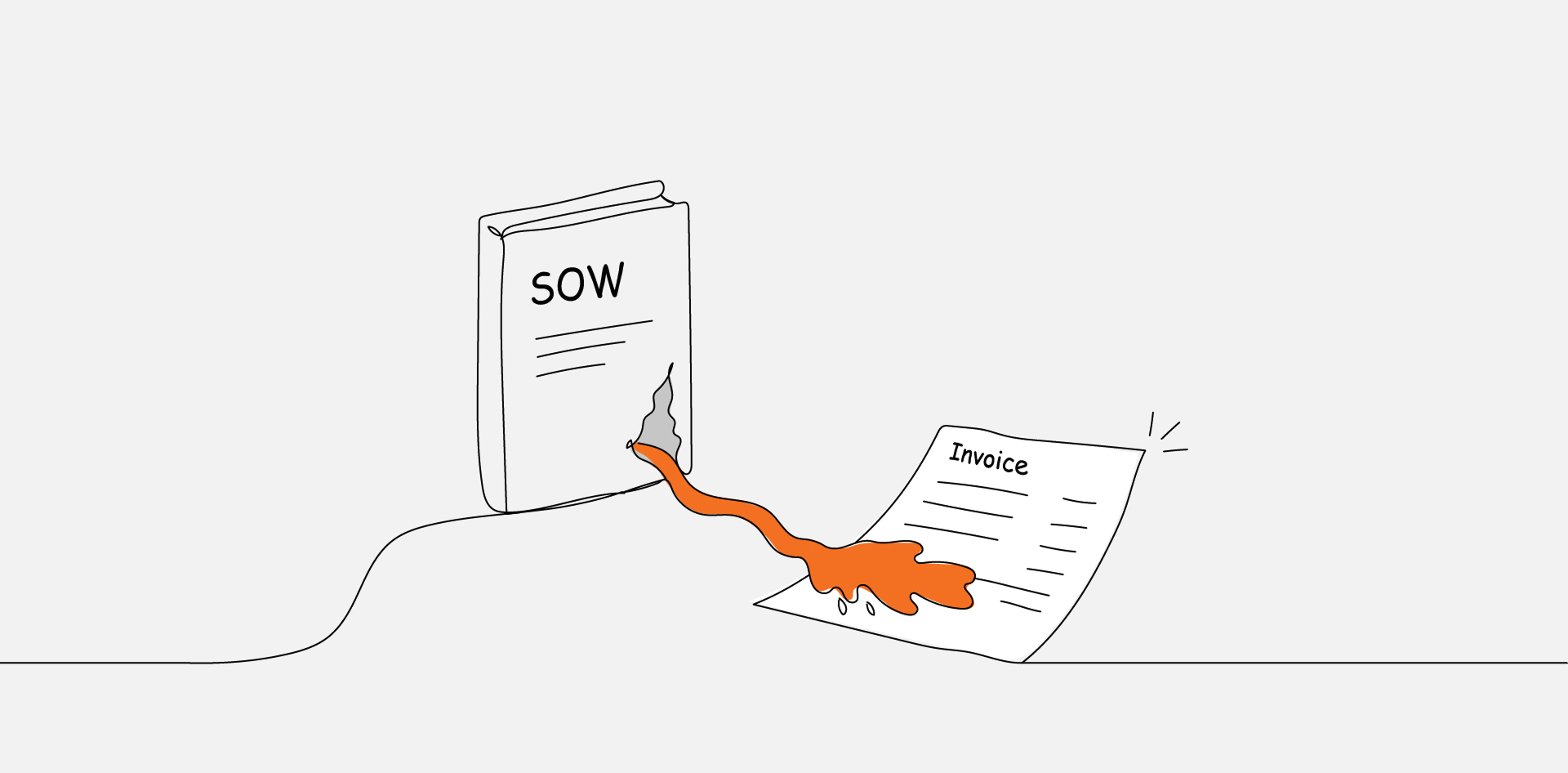
What lands on the invoice is the surface. The cause sits upstream, in the SOW, the kickoff conversation, or a Slack thread that everyone read slightly differently at the time. The teams that handle these moments well treat them less as confrontations and more as feedback.
A first dispute, read carefully, gives you a precise look at which parts of your scoping process are leaking, and what to tighten before the next engagement starts.
Why The First Dispute Is Always Diagnostic
A first invoice dispute is diagnostic because the disagreement almost never starts at the invoice. It starts weeks earlier, at the point where a deliverable, a revision cap, or an approval went undocumented. Reading the dispute backwards tells you which part of your scoping process failed.
Most agencies treat an invoice dispute as a billing event that needs to be resolved before payment can clear. That framing is technically accurate and almost always unhelpful, because the dispute is rarely about the line item the client raised.
The line item is just where the friction surfaced; the friction itself was created earlier, in some specific moment when an assumption went unspoken.
This is why experienced project leads pause before responding. They want to identify the upstream cause, not just clear the invoice.
Trace any disputed line back through the project, and you usually find one of three things: a failure to define project scope anywhere in the SOW, a verbal commitment that never made it into writing, or a change in scope that nobody bothered to formalize.
The reframe is subtle, but it changes how the conversation runs. The goal stops being “win this invoice” and becomes “find the gap, fix it for this client, and prevent it on the next ten.” That’s a meaningfully better outcome, and it’s the only one that compounds across the rest of the book of business.
The Five Triggers Behind Most Invoice Disputes
Most agency disputes don’t come from infinite places. After a few years of running projects across different verticals, the same five triggers show up repeatedly, regardless of client size, service line, or industry.
Naming them out loud makes them easier to spot in your own SOWs before they become invoice problems.
| Trigger | How It Shows Up On The Invoice | The Gap Behind It |
|---|---|---|
| Vague Deliverables | A line item the client reads as broader than you scoped it | No page count, functionality list, or client-side obligations in the SOW |
| Effort Versus Output Ambiguity | An overage charge on work the client believed the fee covered | No cap stated on rounds, hours, or revisions |
| Structural Pricing Confusion | A change billed under one pricing model the client assumed another would absorb | Fixed-fee, time-and-materials, retainer, and milestone terms never distinguished |
| Scope Drift Treated As Inclusion | Charges for requests the client remembers as favors | No change order raised at the moment of the request |
| Undocumented Approvals | A billed deliverable the client denies approving | A verbal yes never confirmed in writing |
Vague Deliverables
“We will build you a website” reads fine in a proposal and reads very differently when the invoice arrives. Without page count, defined functionality, and content scope, the gap fills with assumptions more generous than yours.
Effort Versus Output Ambiguity
The client agreed to a fixed fee for design revisions without realizing the rounds were capped. The third round arrives as an overage, and you are explaining a number that was never bounded up front.
Structural Pricing Confusion
A surprising number of disputes that look like price arguments are really arguments about which pricing structure was supposed to absorb the change.
Scope Drift Treated As Scope Inclusion
Every quick favor and while-you-are-in-there request that never got written up eventually lands on an invoice, and the client will not remember asking for it the way you remember it.
Undocumented Approvals
A verbal yes on a call is not a written one. By the time the work is invoiced, it has quietly become “I never agreed to that,” and you are arguing memory against memory.
Every one of the five traces back to a documentation gap.
How To Trace A Dispute Back To Its SOW
Tracing a dispute means matching the disputed line item to the SOW clause that was supposed to cover it. Either the clause was clear and the client missed it, the clause was ambiguous, or there was no clause at all. Which of the three it is tells you what to fix.
Read the disputed line item carefully, then return to the SOW and locate the clause that was meant to cover it. Three outcomes are possible.
- The SOW addressed it clearly, and the client misread or forgot. That is an awareness gap rather than a documentation gap, and usually the easiest to resolve.
- The SOW addressed it ambiguously, in language that could plausibly be read more than one way. That is almost always your responsibility rather than the client’s.
- The SOW did not address it at all, and both sides have been operating on quiet assumptions for the entire project.
The third case is the one that repeats, because a gap in the template reappears on every engagement built from it. The pattern isn’t unique to agency work. PMI’s 2017 Pulse of the Profession found that a lack of defined objectives and milestones was the most-cited reason organizations gave for failed strategic initiatives, at 37%.
Once you’ve located the gap, ask one more question: when, in week one, could we have prevented this? Was it the website proposal, the kickoff agenda, the deliverables list, the change order template, or the pricing walkthrough?
An honest answer is the actionable part of the diagnosis—and it’s the part most agencies skip, which is why the same disputes keep showing up on the next project.
Documentation Habits That Quietly Prevent Disputes
Disputes don’t disappear because teams get smarter or because a client suddenly becomes easier to work with. They disappear when the documentation around the engagement gets noticeably sharper. A handful of habits, applied consistently across every SOW, neutralize most of the triggers above before they ever reach an invoice.
Specificity in Deliverables
Replace “a website” with “a 10-page WordPress site, three rounds of design revision, written content for six pages provided by the client by [date].” A line item the client can count is much harder to argue with than one they can interpret.
Explicit Out-Of-Scope Clauses
Writing down what’s not included matters more than writing down what is. The inclusion list is easy to forget; the exclusion list rarely is, especially when something later comes up that the client wants and assumes was covered.
A Real Change Order Culture
Anything new becomes a written request scoped and quoted the way ad hoc requests are, not just a conversation. The change order doesn’t need to be a five-page document—a short email with the new scope, the cost, and the timeline impact, acknowledged in writing, is enough to prevent most future disputes.
PMI’s 2018 Pulse of the Profession found that 52% of projects completed in the prior 12 months experienced scope creep, up from 43% five years earlier. Most of that creep slips through because it never gets formalized.
Weekly Status Notes That Flag Drift Early
A short Friday update naming what was in scope, what was added during the week, and what’s still pending closes the gap before the invoice has to do that work for you.
Pricing Examples Written Into the SOW
Show the client what an overage invoice would actually look like, in the SOW itself. The first time they see overage pricing should not be on a real bill.
The Conversation That Resolves Without Damage
Disputes get resolved through client communication more than through contracts, and the order of operations matters more than the wording. The agencies that handle them best follow a fairly consistent pattern, and that pattern doesn’t start with the SOW.
It starts with the client’s underlying goal. Open the call by reaffirming what they were trying to accomplish in the first place. This signals that you’re still on their side even when the invoice has created friction, and it resets the emotional register before the substance of the conversation begins.
From there, acknowledge openly how the misalignment happened. The framing matters more than the facts at this stage. “I can see how this line wasn’t as clear as it needed to be at the start” lands very differently than “you’re misreading the SOW,” even when both statements are technically accurate.
Reference the SOW second, and use it as shared ground rather than as evidence. Then offer two paths forward—a partial credit with a refined change order, a full credit with a tighter scope going forward, or whatever combination fits the relationship.
Writing in Harvard Business Review in 2019, David Frydlinger, Oliver Hart and Kate Vitasek argue that long-term commercial relationships work best when the contract is built to keep both sides aligned over time, rather than held in reserve as evidence for the moment alignment fails.
Close the conversation with a written summary of what was agreed, which becomes the foundation for the rest of the engagement.
Turning Dispute Patterns Into Better Future SOWs
A single dispute resolved well is a one-time gain. The compounding gain comes from treating disputes as data the agency can actually use, rather than as incidents to be filed and forgotten.
The agencies that improve fastest keep a simple internal log of every dispute they encounter—what triggered it, where the SOW failed, how it was resolved, and what the SOW probably should have said.
Over a year of projects, the log starts to surface patterns that no single project could reveal on its own. Maybe most disputes trace back to revision rounds. Maybe a particular service line keeps producing the same misunderstanding, the way a marketing website turns into a web application mid-build. Maybe one client size repeatedly creates the same kind of tension.
These are scoping signals worth taking seriously. Once you can see them clearly, you can build them directly into the SOW template—new clauses, new pricing examples, new clarifying language—so the next project effectively starts where the last one ended.
The same logic applies in onboarding: a 15-minute scope review on every kickoff, walking the client through what’s in the SOW, what’s specifically not, and how change orders work, prevents far more disputes than any clause you can add.
Where This Leaves Your Next SOW
Invoice disputes aren’t failures of process. They’re a useful demonstration of where your process happens to be the weakest right now. Each one carries information that, if you actually use it, makes the next SOW measurably better than the last one.
The agencies that grow steadily over a long horizon aren’t the ones that never face disputes. They’re the ones that treat each dispute as a signal worth listening to, then quietly revise their templates, kickoff calls, and change order habits in response.
The cumulative effect over two or three years is significant: fewer disputes overall, faster resolutions when they do happen, a healthier margin per project, and stronger relationships built on documents that say what they actually mean.
The next time a client questions an invoice, the more useful question isn’t “how do I defend this number?” It’s “What does this dispute tell me about how I scoped the work in the first place?”
Frequently Asked Questions
FAQs
Should I Always Offer A Credit To Preserve The Relationship?
No. Reflexive credits can train clients to dispute every invoice. Assess where the documentation gap actually sits—if the SOW was unclear, a credit is fair, and you should own it.
If the client signed off on the work and is renegotiating after the fact, a credit teaches the wrong lesson. Position concessions as one-time refinements tied to a specific scoping issue, not as a default response to pressure.
Is It Ever Appropriate To Refuse A Dispute Outright?
Rarely, and only when the SOW is genuinely unambiguous, and the work was approved in writing. Even then, a flat refusal almost always damages more than it protects.
The better approach is to walk the client through the relevant clause calmly, ask what triggered the concern, and treat the conversation as information about the relationship, even when you hold the line on the number.
How Do I Write A Change Order Without Making It Feel Transactional?
Frame it as a working document rather than a contract addendum. A short, plain-language email with the change, the cost, and the timeline impact—sent and acknowledged—works better than a formal PDF for most engagements.
When change orders feel like operational hygiene instead of legal escalation, clients stop dreading them, and your team stops avoiding them.
How Should My Team Discuss A Dispute Internally Without Blame?
Run a 30-minute review focused only on the SOW gap, not the people involved. The questions are: what did the document say, what was each side assuming, where did the assumption form, and what should the document have said instead.
Naming the structural gap separates learning from blame and gives the team something concrete to improve in the next SOW.
When Working With An Execution Partner, Who Owns Dispute Resolution?
The agency that holds the client relationship owns it. A good white-label partnership operates on shared scoping discipline behind the scenes—clear deliverables, written change orders, clean documentation—but the conversation with the client always runs through the agency.
The partner’s job is to make that conversation easier with accurate records and clean scope tracking, so the agency can focus on the relationship rather than reconstructing what was agreed.